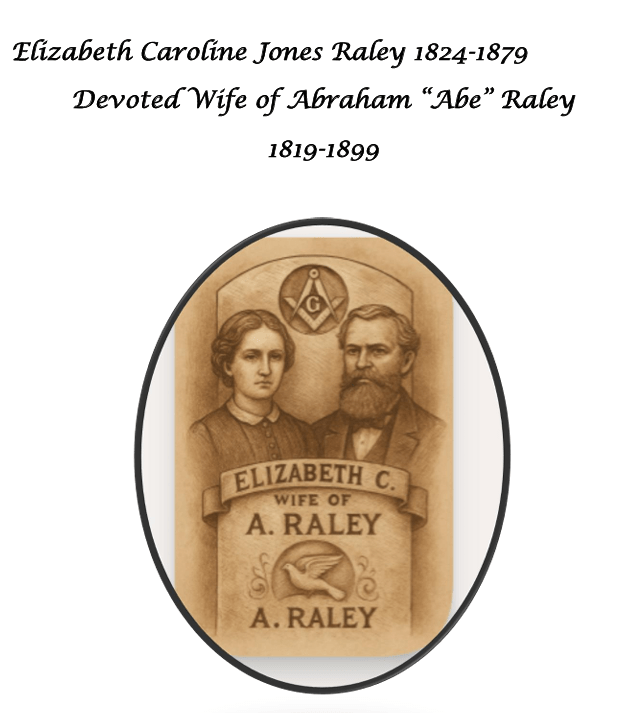
Elizabeth Caroline Jones was the second child of Reverend Wiley T Jones and his wife Sara whose last name is unknown. Wiley Jones was a Baptist minister and farmer. The 1830 census shows the family living in Chesterfield, South Carolina. Elizabeth Caroline would have been the second oldest daughter with four other sisters. These would have been Sarah Jane, Mary Polly, Eliza Ann and Lavinia Jones.
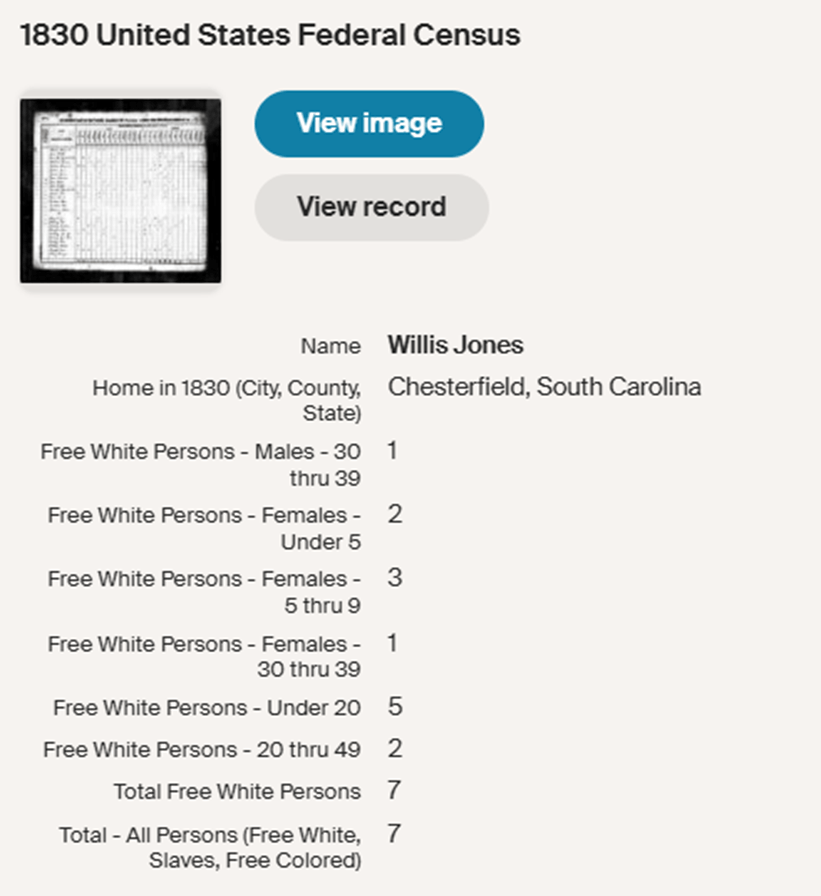
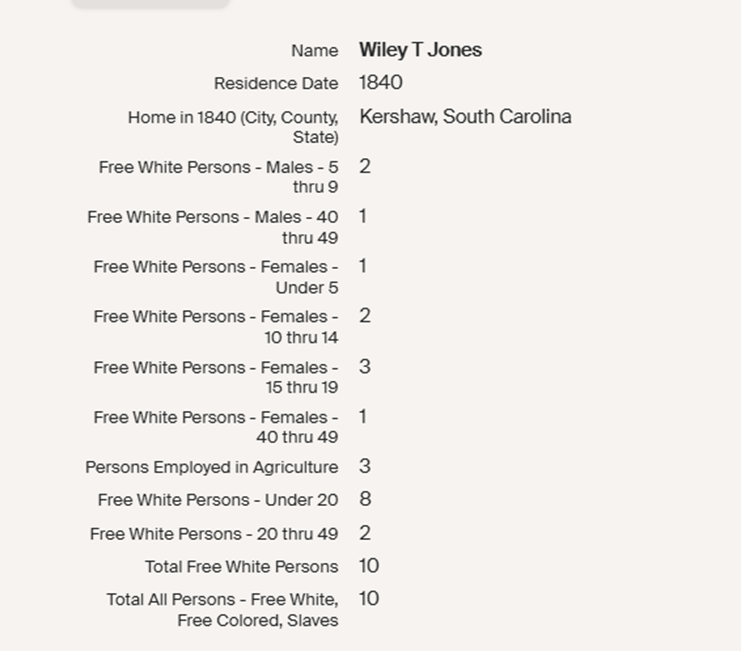
The 1840 census shows the Wiley Jones family living in Kershaw County, South Carolina There are six female children and two male children to make up a family of ten. The six female children are Sarah Jane born 1822, Elizabeth Caroline born 1826, Eliza Ann born 1827, Lavina born 1831, Cynthia Ann “Lucy” born 1833. The two males are Burrell born 1833, and William born 1839.[1]
[1] Year: 1840; Census Place: Kershaw, South Carolina; Roll: ; Page: .
As the daughter of Reverend Wiley T. Jones, a Baptist minister, Elizabeth’s life would have been deeply intertwined with the church. In 1841, she was received into membership at the Mount Pisgah Baptist Church, where her father was the minister (research of Leon Fay Hammond, Jr. at Wofford College). This would have been a significant event in her life, marking her formal commitment to the church and its community.
Daily life for Elizabeth would have involved a mix of household chores, helping to care for her younger siblings, and participating in church activities.
Education for girls in the 1840s was limited, but Elizabeth might have received more instruction in reading and writing than some of her peers, as these skills were important for understanding religious texts. Social activities would have included community gatherings, church events, and visits to neighboring families, providing Elizabeth with opportunities to interact with a wider range of people.
Overall, Elizabeth’s life in Kershaw County during this period would have been shaped by her family responsibilities, religious commitments, and the close-knit community in which she lived.
Elizabeth Caroline Jones married Abraham “Abe” Raley around 1845 in Kershaw County. In 1843. He was a neighbor and was five years older than her. His parents were William Raley born around 1787 on Buffalo Plantation in Kershaw County, South Carolina. His mother was Morning Marie Lowry who was also a South Carolina native.
Abe Raley purchased 200 acres from Richard Terrell in 1847.[1]
Richmond Terrell of Lancaster District, South Carolina, sold 200 acres of land to Abraham Raley of Kershaw District, with the transaction witnessed by William Cato and Samuel Raley, and Richmond Terrell’s wife Rachael Terrell voluntarily relinquishing her claim on the land on March 21, 1846. The deed was officially recorded on October 19, 1847.
In 1850, Elizabeth Caroline Jones Raley and Abraham “Abe” Raley are living in Kershaw County, South Carolina with their three children, James, Wiley and Martha. They are in Household 528.[2]
Elizabeth Caroline Jones Raley and Abe Raley’s neighbors included her two sisters:
[1] “Kershaw, South Carolina, United States records,” images, FamilySearch (https://www.familysearch.org/ark:/61903/3:1:3Q9M-C9PY-47KW?view=explore : Sep 27, 2025), image 315 of 554; . Image Group Number: 007649010
[2] Ancestry.Com. Year: 1850; Census Place: Kershaw, Kershaw, South Carolina; Roll: M432_854; Page: 105B; Image: 213
Elizabeth Caroline Jones Raley and Abe’s Raleys neighbors include her two sisters:
- Household 527 Sarah Jane Jones and Samuel Raley. Samuel Raley was also Abe Raley’s younger brother.[1]
- Household 532 Mary Polly Jones Catoe and William Catoe.[2]
Abe Raley’s neighbor includes his brother Charles Raley and his wife Nancy Moseley who are in Household 535.[3]
William Moseley lives in Household 534. His wife is Nancy Sowell. He is the brother of Nancy Moseley Raley and son of Reddick and Nancy Clyburn Moseley.[4]
Another neighbor is Reddick Moseley and Nancy Clyburn Moseley who are in Household 533. They are the parents of Nancy Moseley Raley. [5]
Another neighbor is Stephen Frank Clyburn and Harriet Hilton who is in Household 529[6].
Abe Raley’s sister Martha Raley is married to William Burrell Catoe. They are living in Household 531.[7]
Nancy Sowell’s sister Elizabeth is married to William Robert Catoe. They are living in Household 530.[8] William Robert Catoe may be the Uncle of William Catoe, husband of Mary Polly Jones Catoe.
[1] Ibid.
[2] Ibid.
[3] Ancestry.Com. The National Archives in Washington, DC; Record Group: Records of the Bureau of the Census; Record Group Number: 29; Series Number: M432; Residence Date: 1850; Home in 1850: Kershaw, Kershaw, South Carolina; Roll: 854; Page: 105b.
[4] Ibid.
[5] Ibid.
[6] Ibid.
[7] Ibid.
[8] Ibid.
Overall, Elizabeth Caroline Jones Raley’s young married life in Kershaw County in 1850 would have been characterized by strong family connections, community involvement, and a deep-rooted religious background. [1]
[1] Ancestry.Com. Year: 1850; Census Place: Kershaw, Kershaw, South Carolina; Roll: M432_854; Page: 105B; Image: 213.
By 1856, the Abraham Raley family had moved from Kershaw South Carolina to Covington County, Alabama.
In 1856, Abraham Raley purchased land in Covington County, Alabama.
On December 25, 1856, Braziel Lewis and his wife Susannah Lewis sold land to Abraham Raley for $700, witnessed by Wm G. Acree and John A. Stewart. On January 18, 1867, Jackson Philips sold 160 acres of land to Abraham Raley for $400, with probate confirmation by Thos P. Court Judge. Both deeds affirm clear ownership and the intention to defend titles against any claims.[1]
[1] “Covington, Alabama, United States records,” images, FamilySearch (https://www.familysearch.org/ark:/61903/3:1:3Q9M-C914-N9RZ-F?view=explore : Sep 29, 2025), image 203 of 235; . Image Group Number: 007737792
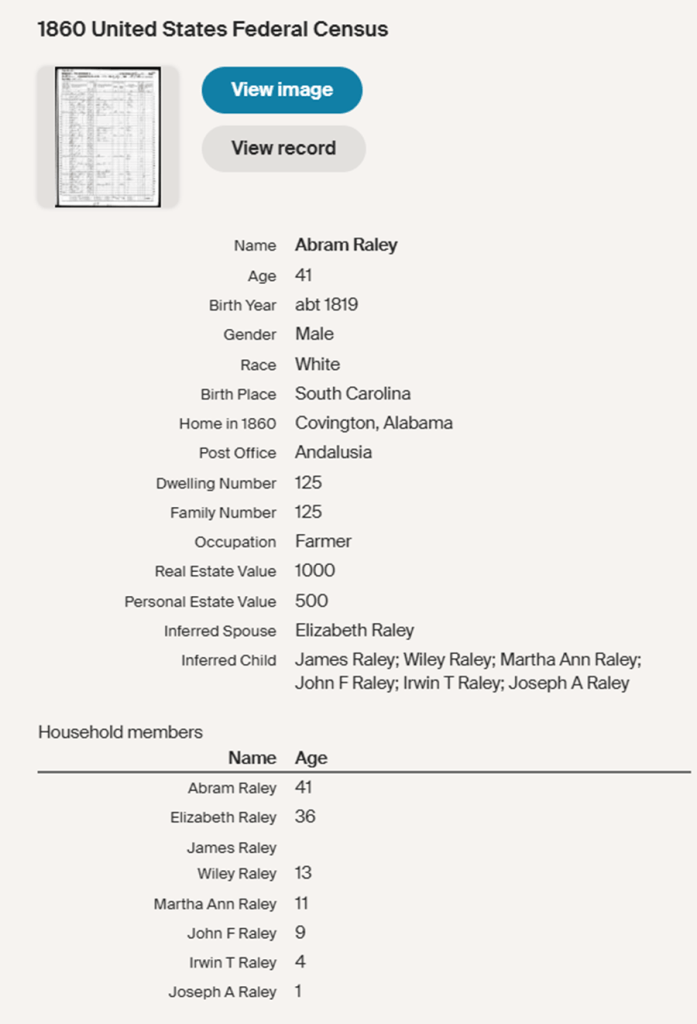
In 1860, Abraham Raley and his family were living in Covington, Alabama. Abraham (age 41) and Elizabeth (age 36) had six children living with them James Raley (15), Wiley (13), Martha Ann (11), John Frank (9), Erwin Thomas (4) and Joseph Abraham (1).[1]
[1] Ancestry.com. The National Archives in Washington D.C.; Record Group: Records of the Bureau of the Census; Record Group Number: 29; Series Number: M653; Residence Date: 1860; Home in 1860: Covington, Alabama; Roll: M653_7; Page: 373; Family History Library Film: 803007
Agricultural practices in Kershaw County, South Carolina, and Covington County, Alabama, in 1855 and 1856 would have differed due to variations in climate, soil, and available resources.[1]
In Kershaw County, the soil was generally fertile and well-suited for growing crops like cotton, corn, and tobacco. The region had a well-established agricultural system, with many farms relying on slave labor for large-scale production. The climate was conducive to these crops, with warm summers and mild winters.
In contrast, Covington County had a different soil composition and climate. The soil in this region was often sandy and less fertile, requiring different farming techniques and crop choices. Farmers in Covington County might have focused more on subsistence farming, growing crops like corn, sweet potatoes, and peanuts, which were better suited to the soil and climate. The agricultural practices would have been more labor-intensive and less reliant on slave labor compared to Kershaw County.
Overall, the move from Kershaw County to Covington County would have required adjustments in farming techniques, crop choices, and labor practices to adapt to the new environment.
Since the Raley’s did not rely on slave labor, Covington County farming might have been more competitive for them.
The religious practices, particularly in the Baptist Church, would have had some differences between Kershaw County, South Carolina, and Covington County, Alabama, during the mid-1800s.
In Kershaw County, Elizabeth Caroline Jones grew up in a family deeply involved in the Baptist Church, as her father, Reverend Wiley T. Jones, was a Baptist minister This involvement meant that her life was centered around church activities, religious education, and community events. The Baptist Church in Kershaw County likely had a well-established congregation with regular services, Sunday school, and various church functions.
When the Raley family moved to Covington County, Alabama, they would have encountered a different church community. While they might have continued their Baptist practices, the social dynamics and community structure would have been different. They would have needed to establish new connections and roles within the local church and community. The Baptist Church in Covington County might have been smaller or less established compared to Kershaw County, requiring more effort to build a sense of community and involvement. They attended Bethany Baptist Church which was established in 1857, soon after their arrival in the County.
Overall, while the core religious practices and beliefs would have remained consistent, the move to Covington County introduced new social and community dynamics that shaped their religious experiences and interactions.
[1] Copilot Query September 29, 2025.
Farming in Covington County was more accessible to smaller farmers who did not or chose not to rely on slave-labor. This would allow them to sustain their livelihoods through subsistence farming and less capital intensive crops.
Abraham “Abe” Raley participated in the Civil War as a member of the Covington County Militia, second class which was organized August 27, 1864. He would have been 48.[1]
[1] Alabama Civil War Service Records Database accessed October 10, 2025.
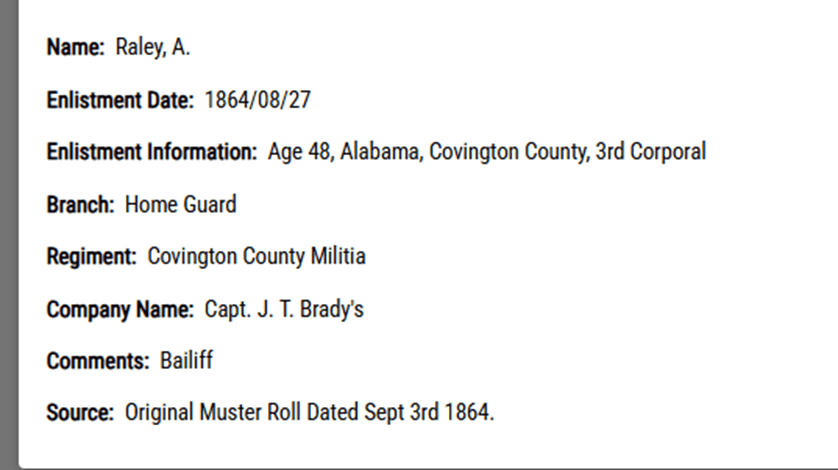
The Covington County, Alabama Militia was organized on August 27, 1864, during the final year of the Civil War as part of the state’s Second Class Militia system. Led by Captain J.T. Brady, this unit was composed of men who were exempt from regular Confederate service due to age, occupation, or other factors. Its primary purpose was to provide local defense, maintain civil order, and support Confederate efforts within the county. These militias were tasked with guarding infrastructure, suppressing dissent, assisting with conscription, and responding to Union raids or emergencies. Their formation reflected the increasing strain on Confederate resources and the need for community-based defense as the war progressed. The Covington County Militia played a vital role in preserving local stability and contributing to the broader Confederate war effort during a time of growing uncertainty and hardship.[1]
In the spring of 1864, as the American Civil War entered its final and most desperate phase, Andalusia was a small but growing settlement in Covington County, nestled in the pine forests of southern Alabama. Though far from the major battlefields, Andalusia played a quiet but meaningful role in the Confederate war effort. Its location along the historic Three-Notch Trail—a military and postal route blazed by Andrew Jackson’s troops decades earlier—made it a strategic waypoint for troop movement and communication.[2]
[1] Copilot Query October 10, 2025.
[2] Copilot Queary September 29, 2025.
Abe Raley’s two sons James Reddick and Wiley are also listed as Veterans.
By the time James Reddick Raley enlisted in March 1864, Andalusia had become a local hub for Confederate recruitment. Men from surrounding farms and communities gathered at the town square, where the courthouse stood, to join regiments like the 27th Alabama Infantry. These late-war enlistees were often younger or previously exempt, answering the call as the Confederacy struggled to replenish its ranks. James Reddick Raley enlisted as a Private in the 27th Alabama Infantry Regiment of the Confederate States Army. He was enrolled on March 23, 1864, in Andalusia, Alabama, by an officer named Abrahams, and soon mustered into active service.[1]
[1] Ancestry.Com. Alabama Department of Archives & History; Montgomery, Alabama; Alabama Census of Confederate Soldiers, 1907 and 1921; Roll: Multiple Regiments (Covington County #20); Roll Number: 184
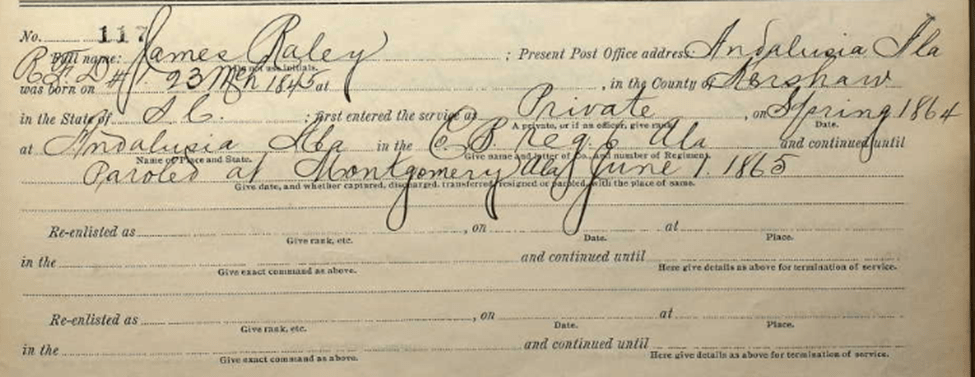
The 27th Alabama had already endured years of hard fighting across Tennessee, Kentucky, and Mississippi. By the time James joined, the regiment was preparing for the brutal Atlanta Campaign, a series of battles that would define the Confederacy’s last stand in the Western Theater. James likely marched alongside weary veterans through the rugged terrain of northern Georgia, facing relentless Union advances, entrenched warfare, and dwindling supplies.
Following the fall of Atlanta, the regiment fought in the Battle of Franklin and Battle of Nashville, where Confederate forces suffered devastating losses. James survived these final campaigns and was paroled in Montgomery, Alabama, in June 1865, as the war came to a close.
In the spring of 1864, as the Confederate States struggled to reinforce their thinning ranks, Younger brother Wiley Raley enlisted in Company E of the 1st Alabama Infantry Regiment, joining from his home in Andalusia, Covington County.[1] His enlistment on April 4, 1864, came during a time of mounting pressure on Southern forces, with Union armies advancing deep into Confederate territory.
[1]Ancestry.Com. National Archives at Washington, DC; Washington, DC; U.S. Census Non-population Schedules, Alabama, 1850-1880; NAID: 2791276; Record Group Number: 29; Record Group Title: Records of the Bureau of the Census, 1790-2007.
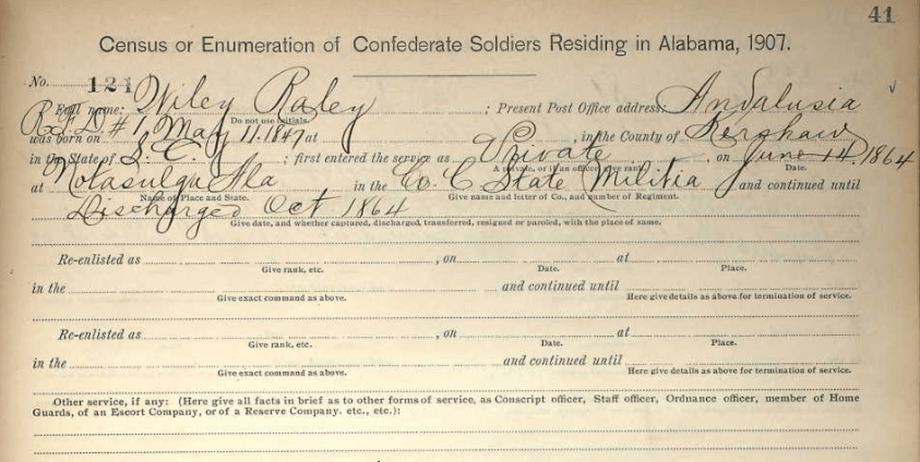
Wiley’s initial service was with the Confederate States Army, but he was later transferred to the East State Militia, continuing in Company E as an infantryman. His time in uniform was relatively short—he was discharged in October 1864—but it reflected the urgency and sacrifice of local men called to defend their homeland in the war’s final year.
1st Alabama Infantry Regiment[1]
Organized in Pensacola, Florida, in March 1861, the 1st Alabama Infantry was one of the earliest Confederate units formed. Initially tasked with manning coastal defenses, the regiment later fought in major campaigns across the Western Theater. By 1864, when Wiley Raley enlisted, the unit had endured heavy losses and was part of General Quarles’ Brigade in the Army of Tennessee, participating in the Atlanta Campaign and the Battles of Franklin and Nashville, where casualties were severe.
East State Militia[2]
The East State Militia was a local defense force, typically composed of older men, younger boys, or those previously exempt from regular service. These units were often mobilized in the war’s final year to defend strategic locations, guard supply lines, and support Confederate operations within their home states. Wiley’s transfer to this militia in late 1864 suggests a shift to more localized duties as the Confederacy’s resources dwindled.
[1] Copilot query September 29, 2025.
[2] Copilot September 29, 2026.
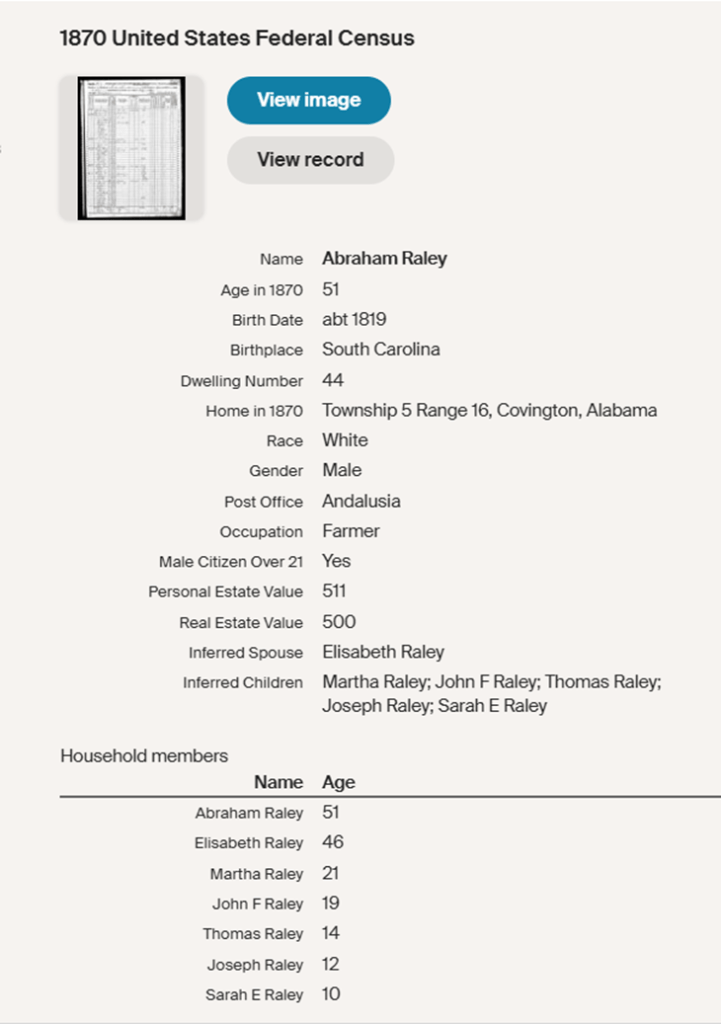
In 1870, Abraham and Elizabeth Caroline Jones Raley are living in Township 5, Range 16 in Covington, Alabama. Five of his children are still at home: Martha (21), John Franklin (19), Thomas Raley (14), Joseph (12) and Sarah E (10). They are in Dwelling 44.[1]
[1] Ancestry.Com. Year: 1870; Census Place: Township 5 Range 16, Covington, Alabama; Roll: M593_11; Page: 481A; Image: 386; Family History Library Film: 545510
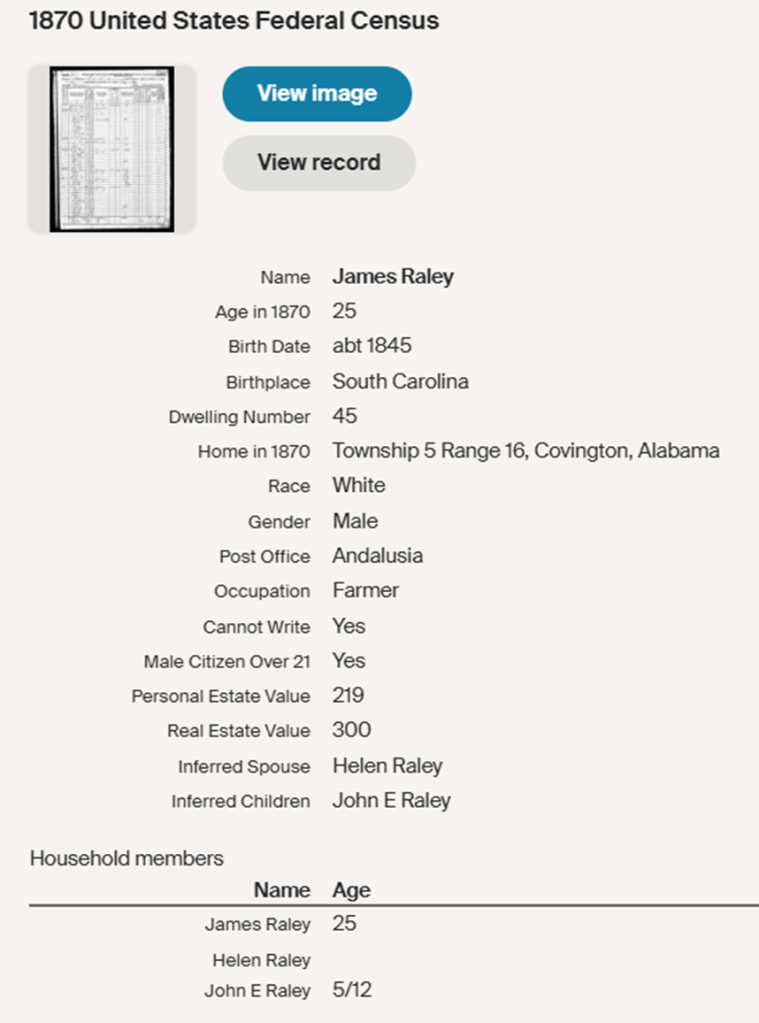
Nearby in Dwelling 45 is James Reddick and his wife Mary Helen Johnson who was a North Carolina native. They married in 1865. They have one baby, John Edmund who is five months old.[1]
[1] Ibid.
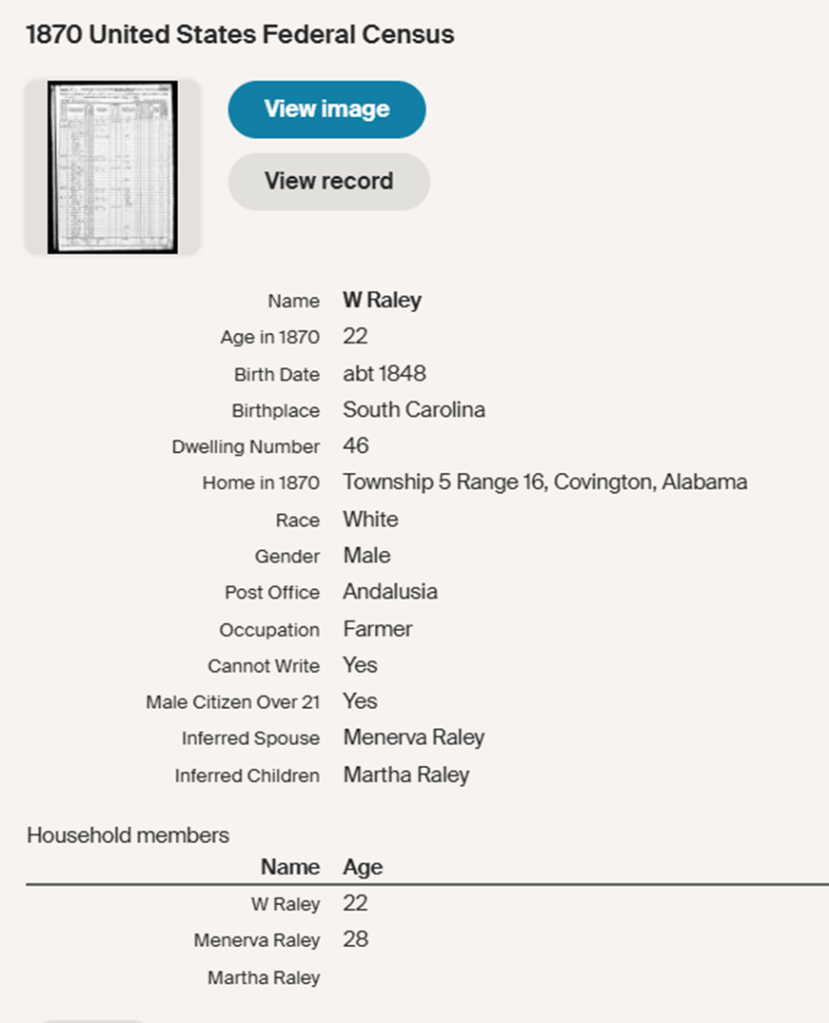
In Dwelling 46 is son Wiley and his wife Minerva. Minerva is a native of Georgia. The couple have a one year old daughter, Martha.[1]
[1] Ibid.
In Dwelling 47, Elizabeth Caroline Jones Raley’s older sister Sarah Jane Jones Raley and Abraham Raley’s younger brother Samuel Raley are living. They have nine children in the home. The two oldest have left home.[1]
Mary Raley Patterson (Samuel and Sarah Jane Jones Raley’s daughter) and her husband Ezekiel are living in Dwelling 48.
Sarah Raley Brown and her husband Aaron (Samuel and Sarah Jane Jones Raley’s daughter) are living in Dwelling 49.
This is a truly a Raley conclave with six Raley family members living next to each other.
[1] Ibid.
The Raley families never owned slaves and were used to subsistence farming so they may have adapted to Reconstruction better than if they had stayed in Kershaw County. It appears that most of their near neighbors were white. Most were in fact, their family.
In 1870 Abraham Raley had 75 acres of improved land, 345 acres of wood land. The value of his farm was $500 and his farming equipment was $20. He owned 4 horses, 4 milch cows, 10 sheep, 18 swine, His stock was worth $511. He produced 300 bushels of Indian corn, 4 bales of cotton, 50 bushels of sweet potatoes, 100 gallons of molasses. The estimated value of the farming goods his farm produced was $1,674.
In 1870 James Reddick, Abraham’s oldest son had 25 improved acres, 55 acres of wood land worth $200. He owned $5 worth of farming implements. He also had 2 horses, 3 other cattles, 6 swine. The value of the livestock was $242. He produced 2 bales of cotton and 50 gallons of molasses. The total value of his farm production was $572.
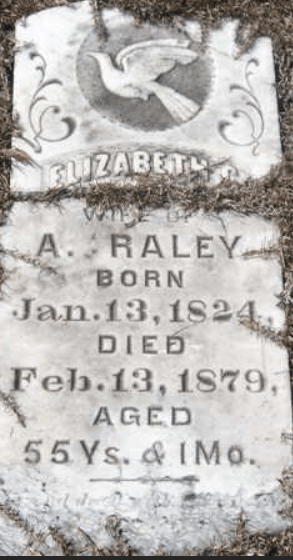
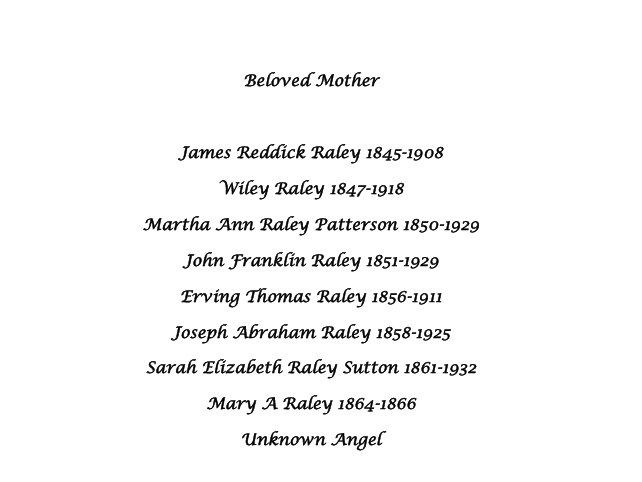
The Raley family lost their matriarch, Elizabeth Caroline Jones Raley in 1879. She died at age 55. She had nine children, seven who lived to adulthood. She was buried at Bethany Baptist Church in Andalusia, Covington County, Alabama.[1]
[1] Find A Grave at Elizabeth C Jones Raley (1824-1879) – Find a Grave Memorial accessed October 1, 2025.
In 1891, Abraham “Abe” Raley got choked at a Masonic Celebration.[1] He was able to be cured[2]
[1] Newspapers.com – The Standard Gauge – 2 Jul 1891 – Page 2
[2] Newspapers.com – The Covington Times – 4 Jul 1891 – Page 3.
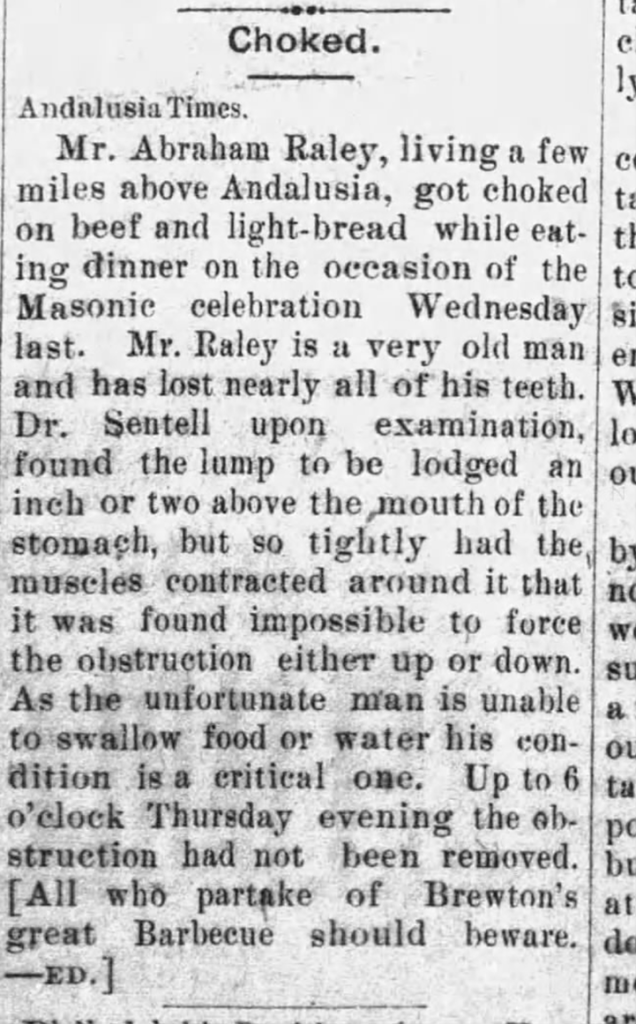
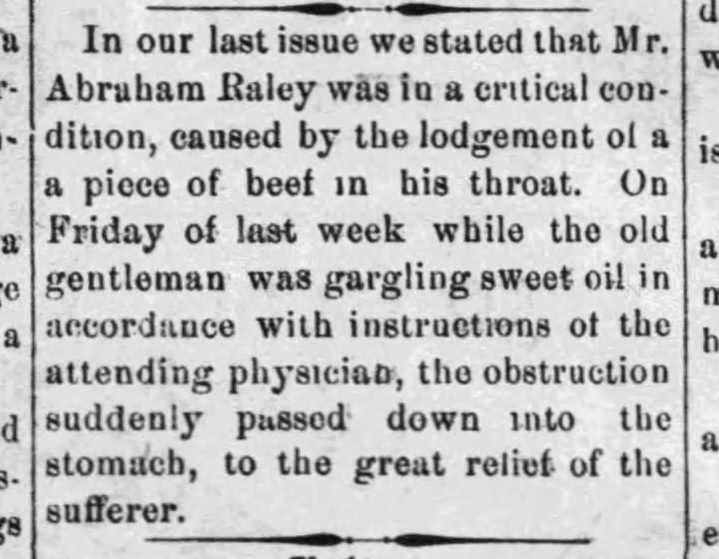
Abraham “Abe” Raley lived until 1899 and never remarried after the death of his wife Elizabeth Caroline Jones Raley in 1879, outliving her by 20 years. He is buried at Bethany Baptist Church with his wife, Elizabeth Caroline.[1] Abe Raley was an old and honored member of the Masonic Fraternity and had a Masonic ceremony despite heavy rain.
A Masonic funeral in 1899 would have been a solemn, symbolic ceremony led by lodge members in full regalia. Held at a church or graveside, it included:
- Procession of Masons by rank, wearing aprons and white gloves
- Prayers and Scripture, often Psalm 90 or Ecclesiastes 12
- Eulogy honoring the brother’s life and service
- Symbols like the sprig of acacia (immortality), white gloves (purity), and apron (labor)
- Hymns such as “Nearer, My God, to Thee”
- Final Rites with a graveside ritual and benediction, committing the brother to the “Celestial Lodge above”
It blended Christian faith with Masonic tradition, reflecting both personal virtue and fraternal legacy[2].
[1] Find A Grave at Abraham Raley (1819-1899) – Find a Grave Memorial accessed October 1, 2025.
[2] Copilot query October 1, 2025.
Transcription: Death of Mr. Abraham Raley. Mr. Abe Raley, Mr. Abe Raley, Sr. after several weeks sickness, died of dropsy at the home of his son-in-law, Mr. Zach Sutton, a few miles above town, on Wednesday night, the 19th of July, in his 80th year. He had the small-pox a few months ago, and no doubt the dregs of this disease in his system hastened his death. Deceased had been a loyal and consistent member of the Missionary Baptist church for about fifty years. Since his death there are only now two known to be living who were in the organization of the Bethany church. Mr. Raley came to Covington county from South Carolina in 1856. He leaves seven children living and two dead; grand-children 56, 10 of whom are dead and 15 great-grand children; and one dead. His wife having died in 1870, aged 51 years old. The remains were laid to rest in the cemetery at Bethany church on Friday, the 21st of July. The pastor, Rev. W. P. Howell, performed the usual burial services, after which the Masonic Fraternity, of which deceased was an old and honored member, took charge and interred the remains in a solemn and impressive manner. Owing to the heavy rain, only seventeen masons were present, as follows:
Andalusia lodge – O.F.C. Moore, W.M.; Dr. M. Baggott, SW.; W.A. Diamond, J. W.; A.T. Powell, S.D.; J.M. Bell, J.D; Rev. D.B. H. Jeffcoat, Chaplain; E. Lindsey, Treasurer L.J. Salter, Secretary; Jas. Davis, Tyler, Dr. T. L. Sellers, S. J. Houston, J. A. McKenzie, S.S. Leonard
Rose Hill Lodge – A.W. H. Carr, J.B Carr
Bearright Lodge – G.W. Duncan, Jas. Rainer
Fairmount Lodge – Barus Bollock.
The story of Elizabeth Caroline Jones Raley and Abraham “Abe” Raley, and their descendants, is a vivid tapestry woven from threads of resilience, migration, faith, and family legacy. From their roots in South Carolina to their settlement in Covington County, Alabama, the Raley family’s journey reflects the broader American experience—shaped by the challenges of war, the upheaval of Reconstruction, and the pursuit of opportunity in new lands.
Descendants of Elizabeth Caroline Jones and Abraham “Abe” Raley
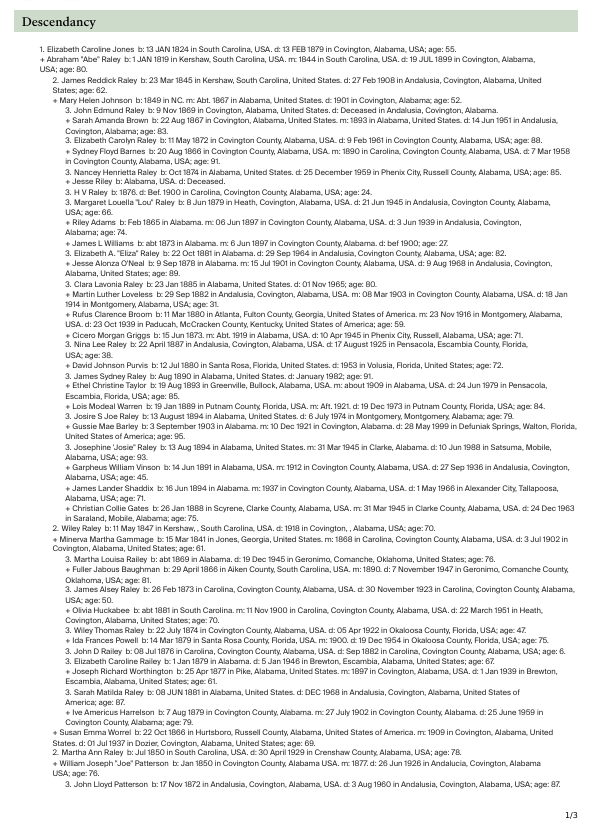
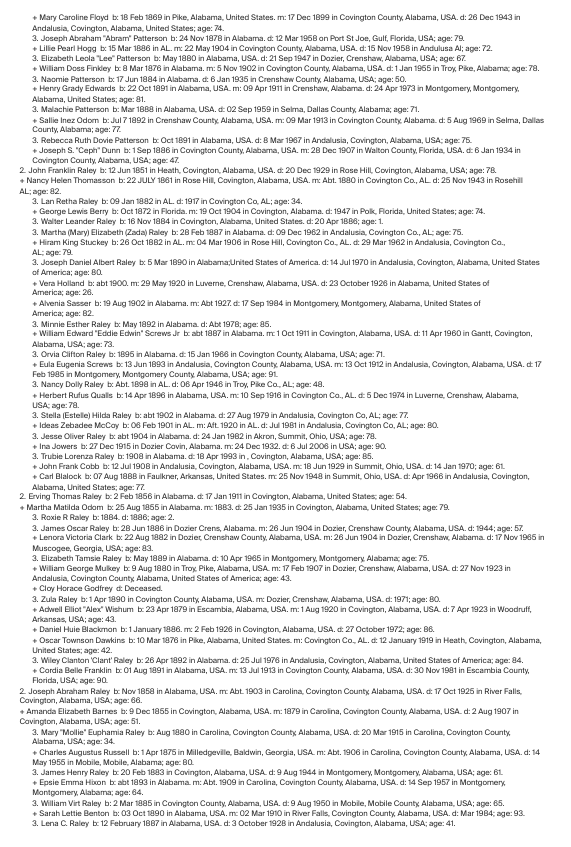
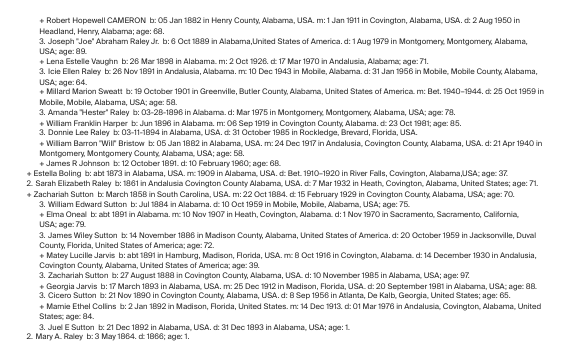
 Martha's Family Connections