Time is But A Shadow
Dedicated to the faith, love and sacrifices of the sturdy pioneers who have gone before
A lot of researchers have confused Abram Coble with Abram Fox Coble
BOTH born abt 1790-1798 Guilford Co., NC…
BOTH with wives named Mary born the same year
BOTH with a son named Alfred and a daughter named Letita
.
BOTH DIED IN GUILFORD CO., NC in 1847–about10 months apart-
ABRAM “FOX” COBLE DIED DEC 18 1847…
ABRAM COBLE DIED ABT FEB 4 1847….
Both are buried at Coble’s Lutheran Church[1]
[1] Find A Grave at Abram “Abraham” Coble (1798-1847) – Find a Grave Memorial accessed February 2, 2024.
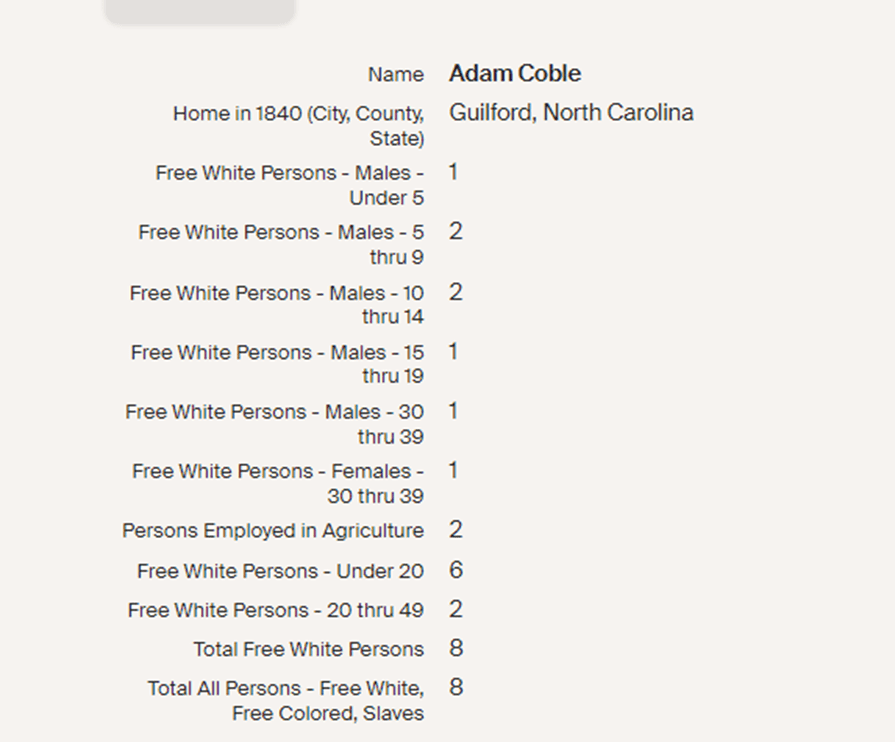
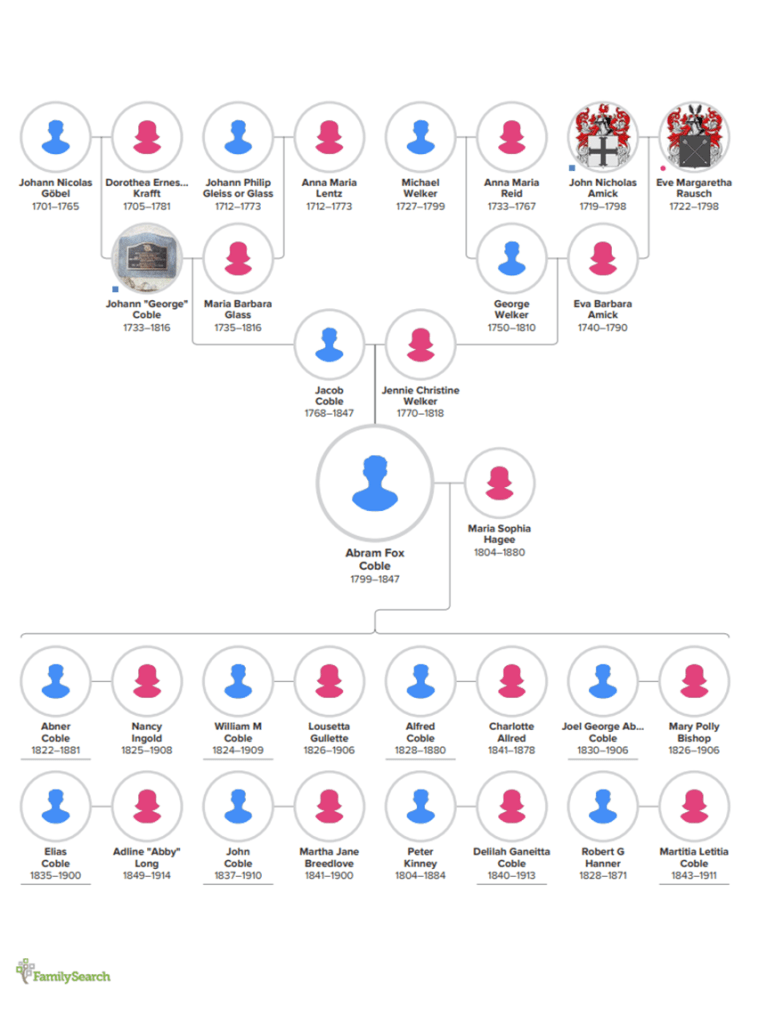
Abram Fox Coble’s mother and father were Jacob Coble and Jane Jennie Welker. He was born around 1798.[1]
[1] Ancestry.Com. North Carolina, U.S., Historical Records Survey, Cemetery Inscription Card Index, 1700-2018.
Abram Fox Coble and his family were living in Guilford County in the 1830 census. The two male children were most likely Abner and William. His neighbors were Arnold, Garrett, Shatterly, Layton, Forbis, Lowe, Coble, Clapp, Staley and Phillippie.[1]
[1]Ancestry.Com. 1830; Census Place: Guilford, North Carolina; Series: M19; Roll: 121; Page: 125; Family History Library Film: 0018087.
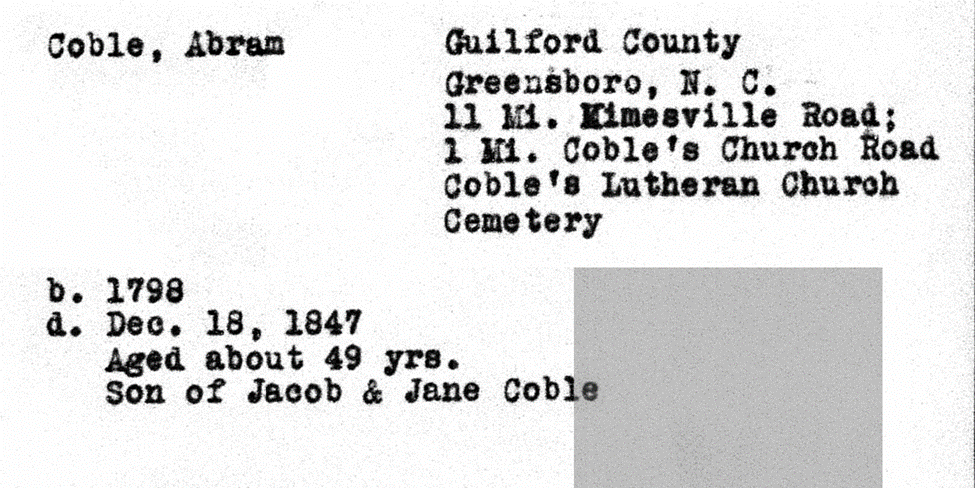
Abram Fox Coble and his family were living in Guilford County in the 1840 census. The six male children could have been his six sons who lived to adult hood: Abner, William, Joel, Alfred, Elias, and John. His neighbors were Staley, Coble, Smith, Shoe, Amick, Allred, Hagey and May.[1]
One of the sons could have been Jonathan Calvin Coble. In the list of funerals Dr. George Welker preached in the Guilford Genealogist[2], one of them was for this child. The funeral was April 18, 1845. The child was ten years old so he would have been born in 1835.
[1] Ancestry.Com. Year: 1840; Census Place: , Guilford, North Carolina; Roll: ; Page: .
[2] The Guilford Genealogist, Journal 19, page 4.

Abram Fox Coble[1] was ordered by the Courts to work on the roads. This was the way that roads were maintained in the early 19th century. He worked along side his neighbors from 1824 to 1836, working on the roads near the Alamance county line.
[1] It is difficult to tell which Abram (Abraham Coble) would have been ordered to work the roads or if both of them were.
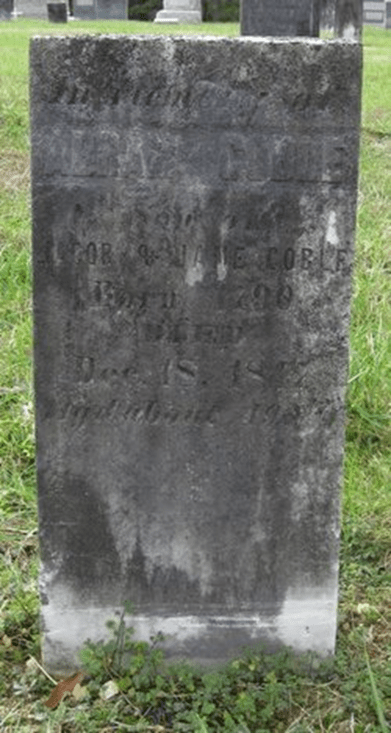
Abram Fox Coble passed away on December 18, 1847. He was buried at Coble’s Lutheran Church in Clay Township in Guilford County, not far from Randolph County and Alamance County lines.[1]
[1] Find A Grave at Abram Coble (1790-1847) – Find a Grave Memorial accessed February 3, 2023.
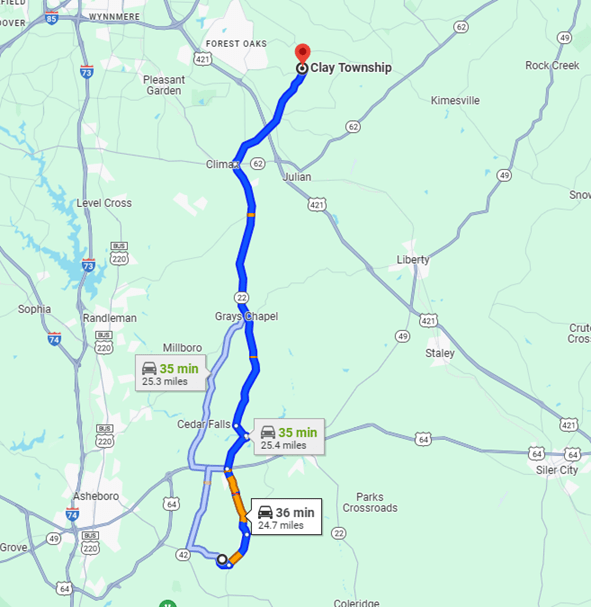
Coble’s Lutheran Church was organized in 1812 under the name of Zion by Reverend Jacob Sherer. Pastor Sherer was the pastor of Low’s Lutheran Church in Guilford County and Richland Lutheran Church in Randolph County.[1]
[1] The Guilford Genealogist, Published by The Guilford County Genealogical Society of NC, Volume 14, No 3, Spring 1987, Number 37, page 109.
The settlers in the area around Coble’s Lutheran Church in Guilford County came down from Pennsylvania on the Great Wagon Road. They were Lutherans and Reformed Lutherans. The land was donated by Valentine Clapp in 1816. The Church was used by both the Lutherans and Reformed Lutherans. It is not known which group Abram and his family belonged to. The Reformed Lutherans were strict in their beliefs. They did not believe in driving their wagons except to church on Sunday. They did not believe in whisky or in dancing. They also did not believe in slavery. The Reverend George Welker who was the pastor at the nearby Brick Church was nearly hanged for his anti-slavery posture.[1]
[1] Find A Grave at Rev George William Welker (1817-1894) – Find a Grave Memorial accessed February 3, 2024.
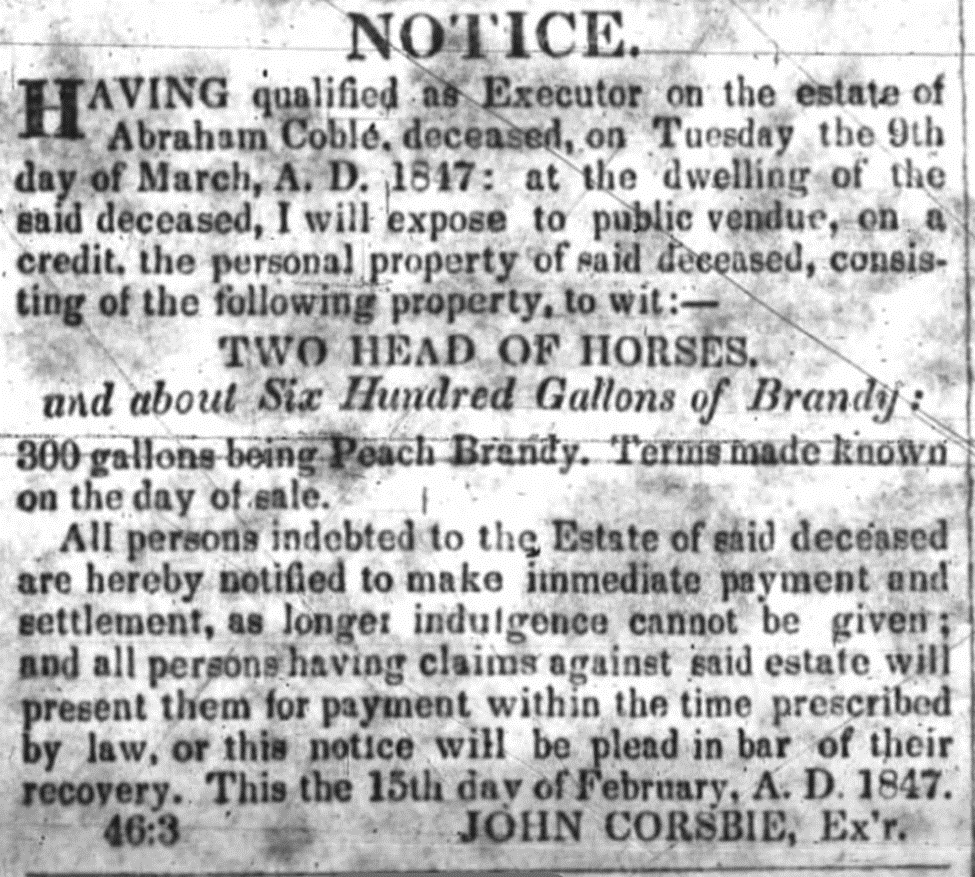
One way to tell Abram Fox Coble from the other Abram Coble is the other Abram Coble produced brandy. Our Abram may have been a Reform Lutheran as there is no evidence of him being involved in the whisky trade.[1]
[1] Newspapers.com – The Greensboro Patriot – 1847-02-27 – Page 4 Abram Coble estate sale two horses and 600 gallons of brandy.
Both the Lutherans and the Reformed Lutherans used the Coble’s Lutheran Church building. They had their church services on different Sundays.

Coble’s Lutheran Church is a beautiful church. “It stands today as an enduring witness of the gospel and to the faith, love and sacrifices of the sturdy pioneers who have gone before and who have given expression to their devotion….”[1]
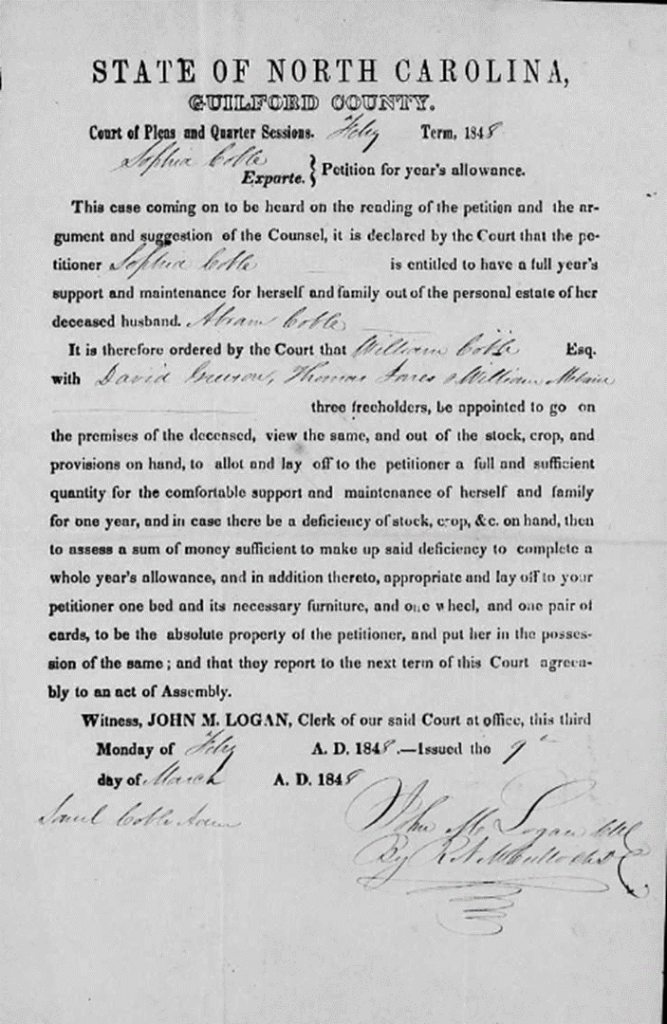
Abram died without a will. In the July Term of 1848, his wife Sophia petitioned the Court for a full year’s support and maintenance for herself and family out of the personal estate of her husband, Abram Fox Coble.[1]
[1]Abram Coble, “North Carolina Estate Files, 1663-1979” • FamilySearch.
The court appointed William Coble, Esquire along with David Greeson, Thomas Jones, and William Mebain to allot and lay off a sufficient quantity for the support and maintenance of herself and her family for one year.
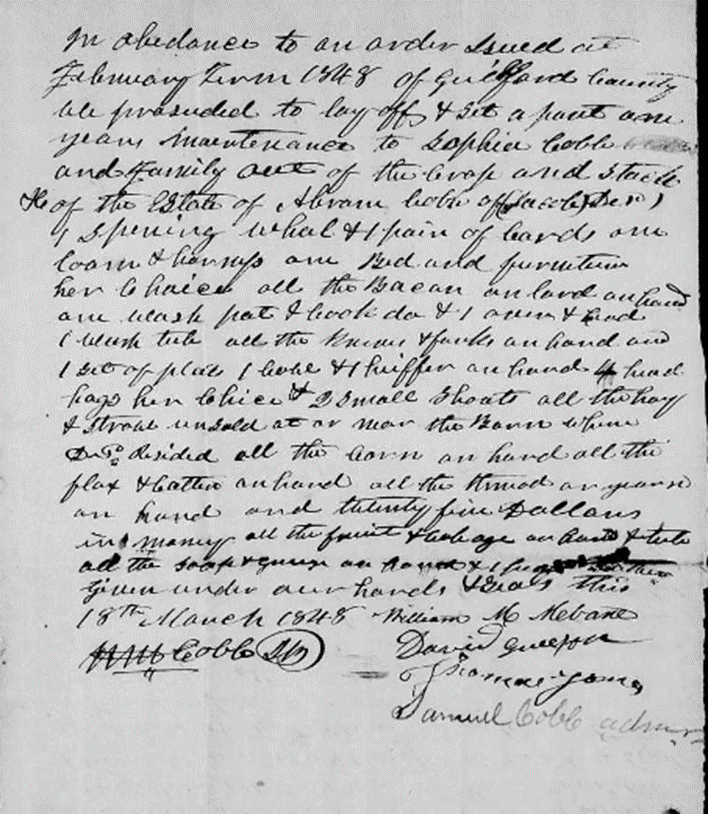
Transcription: In obedience to an ordered issued at February Term 1848 of Guilford County we proceeded to lay off and set apart one years maintenance to Sophia Coble and family out of the crop and stock of Abram of Jacob (Sen), 1 spinning wheel & 1 Pair of cards one loom & harness one bed and furniture her choice all of the bacon and lard on hand one wash pot & cook do? & 1 oven & ? 1 wash tub all the knives & forks on hand and 1 set of plates 1 cow & 1 heiffer on hand head hog hen chickens & 2 small shoats all hay & straw unsold at or near the barn where dec(eased) resided all the corn on hand all the flax & cotton on hand all the? Or yarn on hand and twenty five dollars in money all the fruit & cabbage and beets & potatos all the ? and ? on hand & ? given under our hands & seals this 18th March 1848.
WM Coble (Esq) William M Mebane
David Greeson
Thomas Jones
Samuel Coble, Administrator.
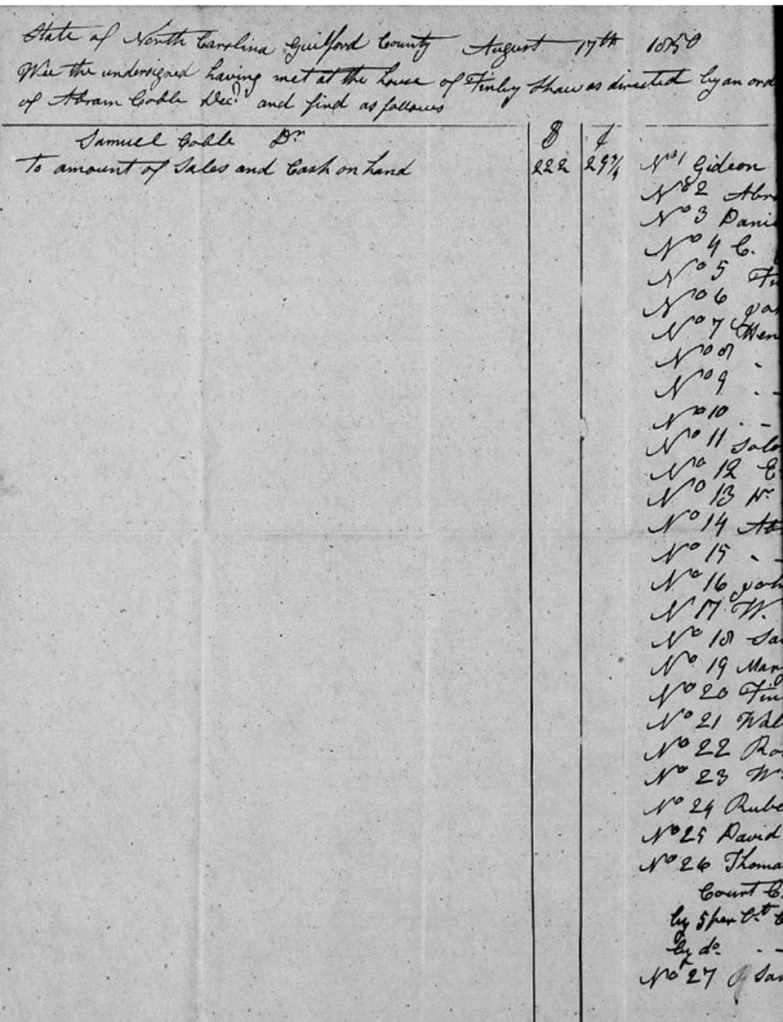
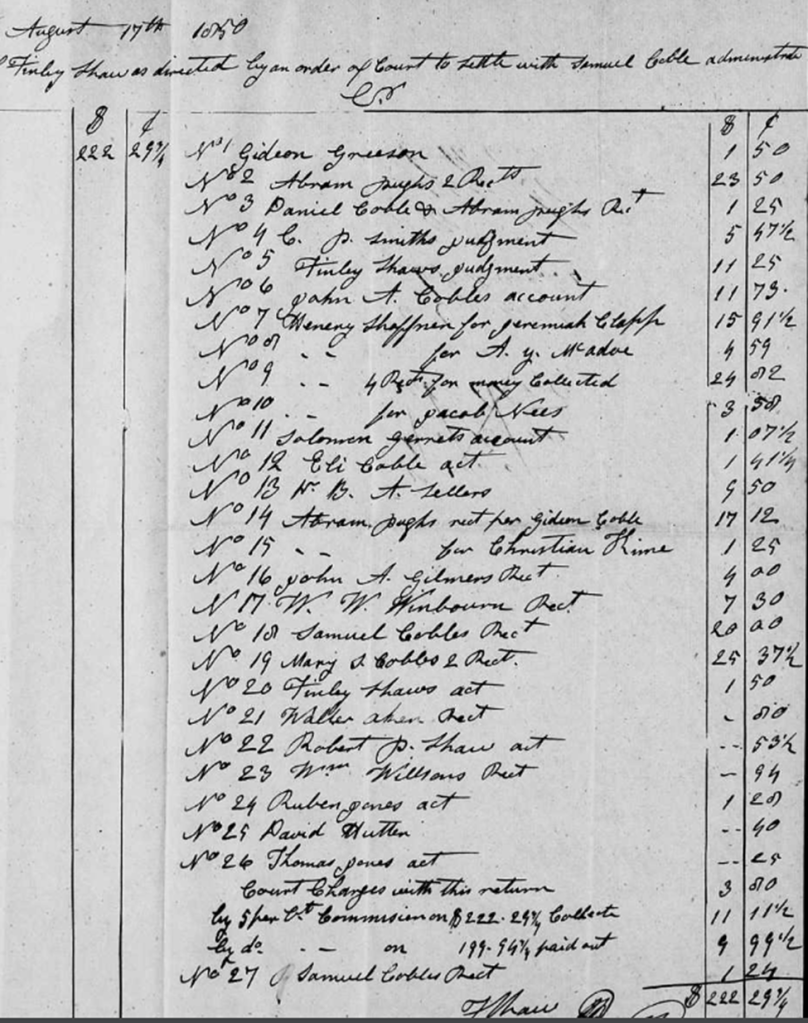
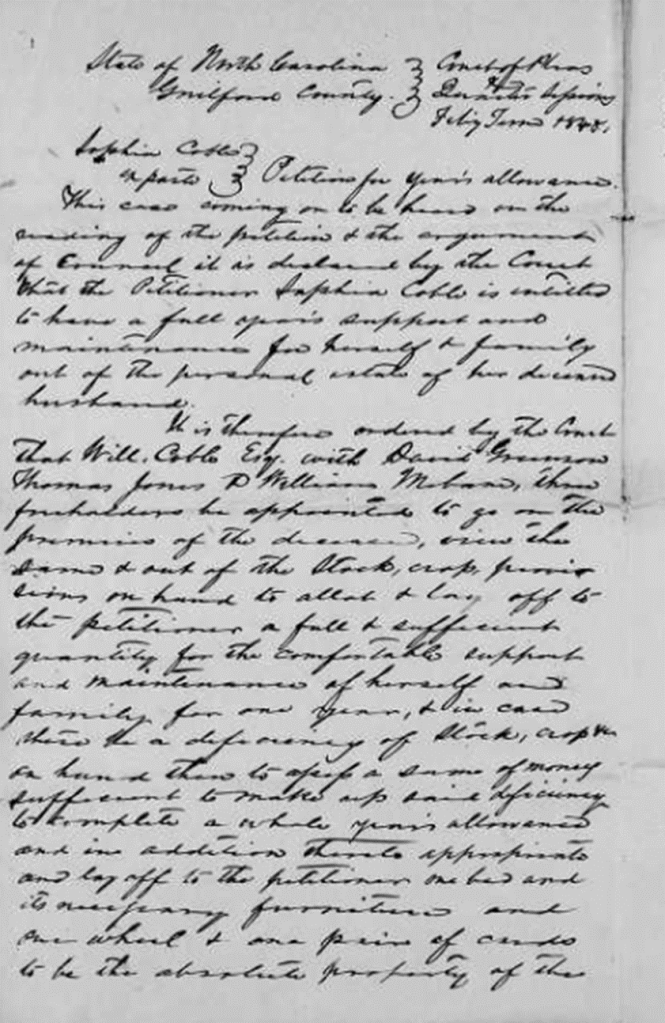
Transcription: State of North Carolina Guilford County Court of Pleas and ___ Sessions July Term 1848
Sophia Coble exparte
Petition for Year’s allowance. This case coming on to be heard on this reading of the petition and the agreement of the Counsel it is declared by the Court. That the Petitioner Sophia Coble is entitled to have a full year’s support and maintenance for herself & family out of the personal estate of her deceased husband.
It is therefore ordered by the Court that Will.Coble Esq with David Greeson Thomas Jones D William Mebane, three freeholders be appointed to go on the premises of the deceased, view the same & out of the stock, crop, provisions on hand to allot & lay off to the petitioner a full & sufficient quantity for the comfortable support and maintenance of herself and family for one year, & in case there be a deficiency of stock, crop on hand then to assess a sum of money sufficient to make up said deficiency to complete a whole year’s allowance and addition then to appropriate and lay off to the petitioner one bed and its necessary furniture and one wheel one pair of cards to be the absolute property of the petitioner and petitioner and put her in possession of the same, and that they report to the next Term of this Court agreeably to an Act of assembly.
Maria Sophia Hagey 1804-1880
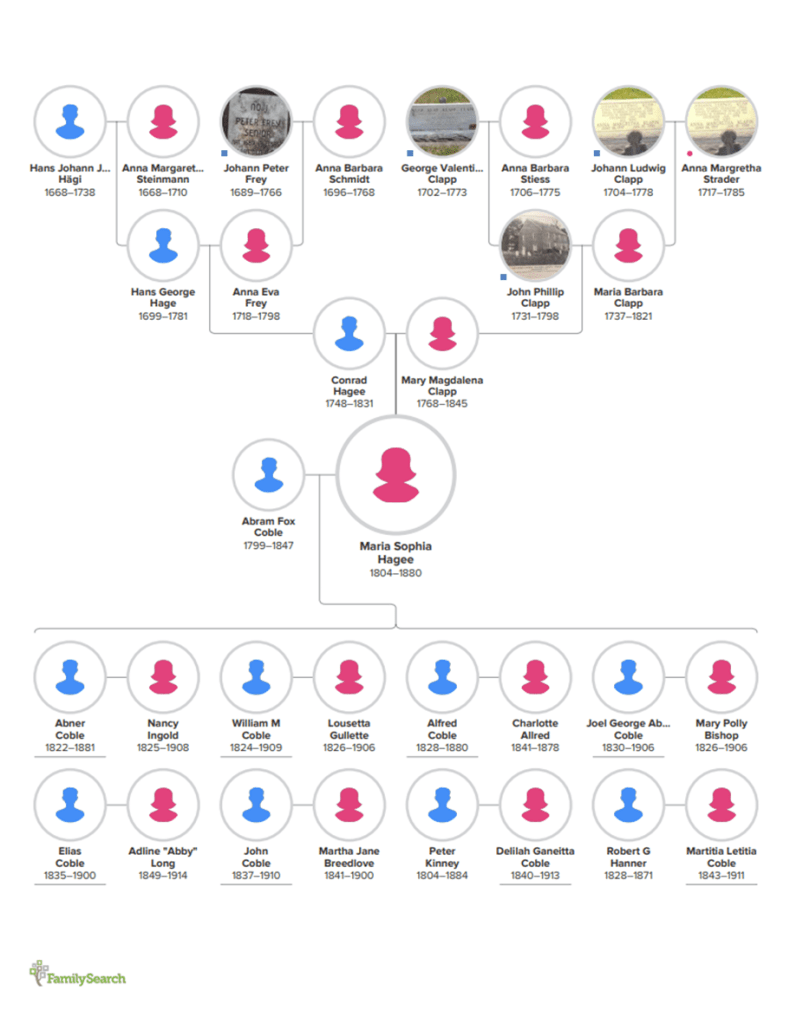
Maria Sophia Hagey was the daughter of Conrad Hagey and Magdalena Molly Clapp. This 1824 deed divides her father’s land.[1]
[1] Guilford County Register of Deeds Book 19, Page 400.
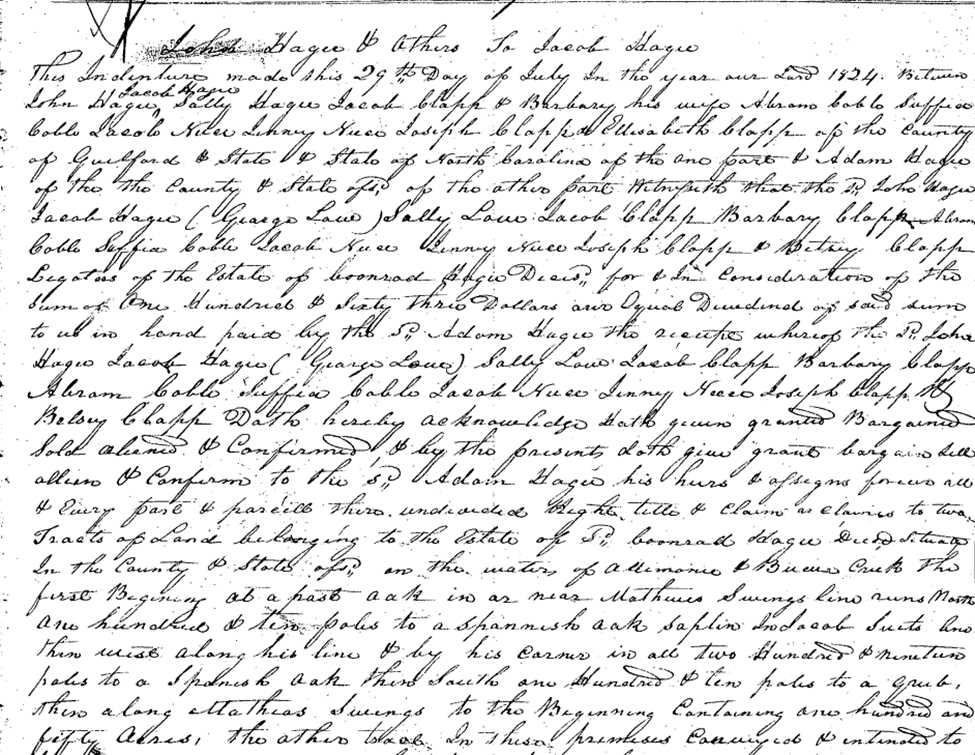
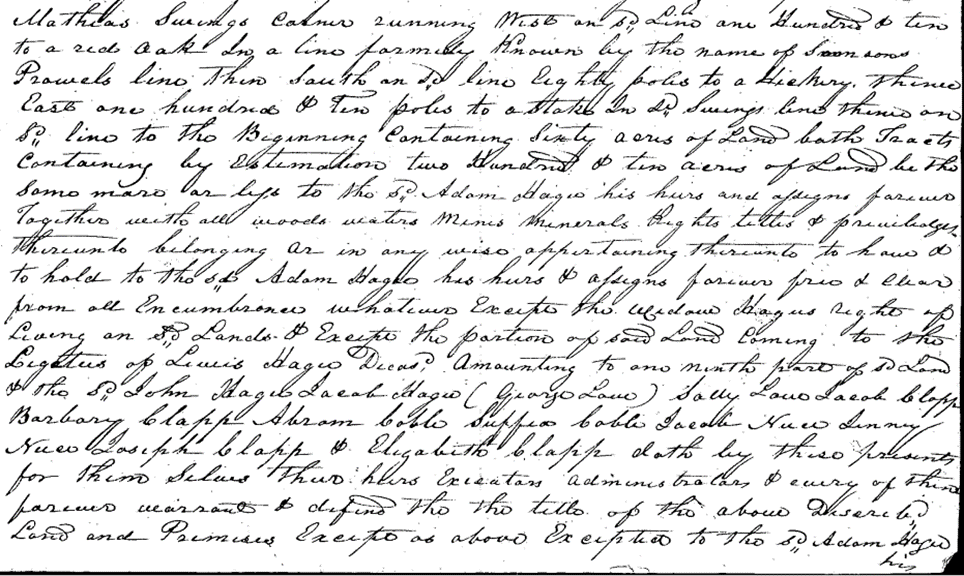
This Indenture made this 29th Day of July in the year of 1824. Petitioner John Hagea Jacob Hagea Jacob Clapp & Barbary his wife Abram Coble Soffia Coble Jacob Neese Jenny Neese Joseph Clapp & Elizabeth Clapp of the county of Guilford State of North Carolina of the one part & Adam Hagea of the County & state of the other part witnesseth that the John Hagea Jacob Hagea George Lowe Sally Lowe Sarah Clapp Barbary Clapp Abram Coble Soffia Coble Jacob Neese Jinny Nees Joseph Clapp & Betsy Clapp legatee of the Estate of Conrad Hagea Deced for consideration of one hundred sixty three dollars and ____of said sum to us in hand paid by the sd Adam Hagea the receipt whereof the R John Hagea Jacob Hagea (George Lowe) Sally Lowe Jacob Clapp Barbary Clapp Abram Coble Soffia Coble Jacob Neese Jinny Neese Joseph Clapp Betsy Clapp doth hereby acknowledge hath given granted bargained sold __ and confirm to the sd Adam Hagea his heirs & assignees forever all & every part & parcel the undivided rights, titles & claims to two tracts of land belongin to the Estate of Conrad Hayes Deced situate in the County and State upon the waters of Alamance @ Burnee Creek the first beginning at a post oak in or near Mathias’s Swing line runs north one hundred and ten poles to a Spanish Oak Soslin and Jacob Suits line the west along his line & by his corner two hundred & nineteen poles to a grub then along Mathias Swing line to the beginning containing one hundred and fifty acres, the other in these premises conveyed & intended to be conveyed adjoining the above tract to post oak Matthias Swing’s corner running West on said line one hundred and ten to a red oak to a line formerly known by the name of Soonson’s Prowels line then South on sd line eighty poles to a Hickory then Hence East one hundred ten poles to a stake in the Swing line thence on So line to the Beginning containing sixty acres of land both Tracts containing by estimation two hundred & ten acres of Land be the same more or less to the SP Adam Hagea his line and assignees forever Together free and clear from all encumbrances whatever except the Widow Hagea right of living on the Lands the portion of the said land coming to the Legatees of Lewis Hagea decsd amounting to one nineth piece of the land of the John Hagea Jacob Hagea (George Lowe) Sally Lowe Sarah Clapp Barbary Clapp Abram Coble Soffia Coble Jacob Neese Jinny Neese Joseph Clapp & Elizabeth Clapp do by these presents for them sellers their heirs executors, administrators & every of them forever warrants & defend this title of the above described land and premises except as above Excepted to the SD Adam Hagea.
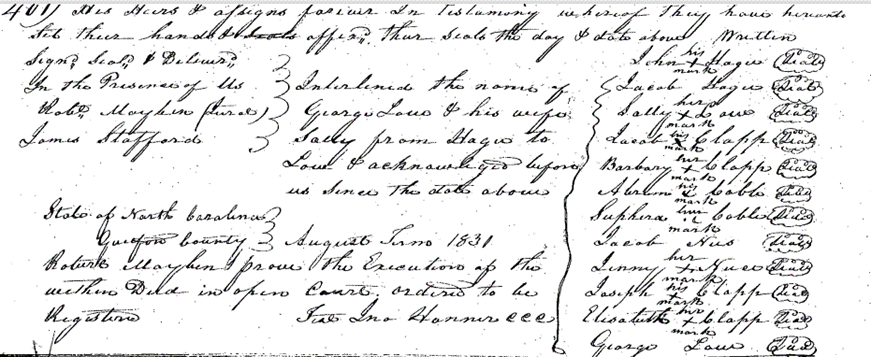
His Heirs assignees forever in testimony whereof they have hereinto set their hands and officers their seals the state and date above. Written, signed, delivered and sealed in the presents of Robert Mayhen and James Stafford.
Underlined the name of George Lowe & his wife Sally from Hagea to Lowe & acknowledge before us since the date above.
State of North Carolina
Guilford County August Term 1831
Robert Mayhen prove the execution of the within Deed in open Court ordered to be registered.
Teal Ina Hanner CCC
John Hagea his mark Seal
Jacob Hagea his mark Seal
Sally Hagea her mark Seal
Jacob Clapp his mark seal
Barbary Clapp her mark seal
Abram Coble his mark seal
Sophia her mark seal
Jacob Nees his mark seal
Joseph Clapp his mark seal
Elizabeth Clapp her mark seal
George Lowe his mark seal
In the 1850 census, the widow Mary Sophia Clapp is living with her children in the Southern Division of Guilford County. The children are Abner (22), Joel (20), Elias (15), John (13), Delilah (8), and Letitia (6).[1]
[1] Ancestry.Com, Year: 1850; Census Place: Southern Division, Guilford, North Carolina; Roll: M432_632; Page: 364B; Image: .

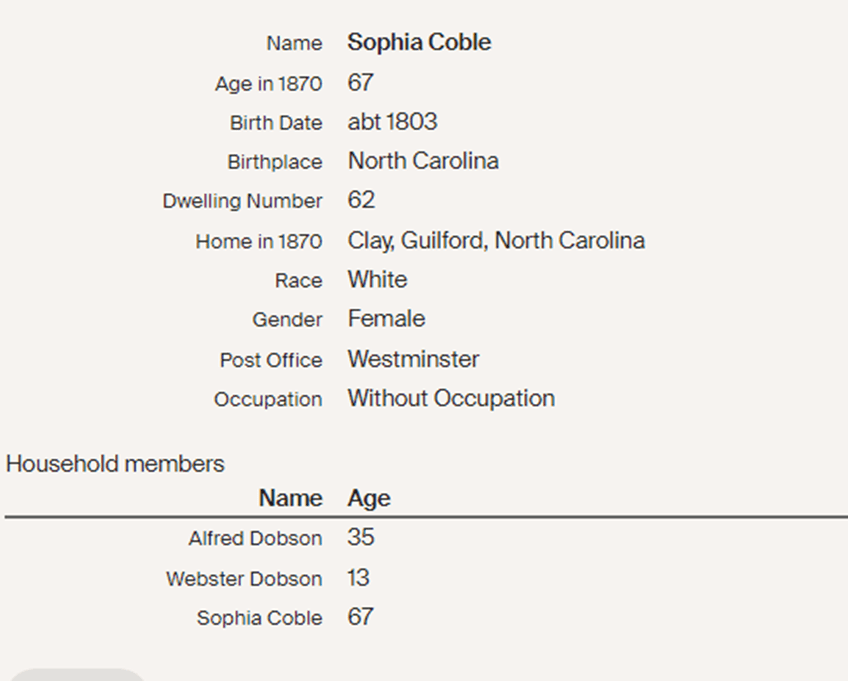
In 1860, Mary Sophia is living with her youngest daughter Letitia in the southern division of Guilford County.[1]
[1] Ancestry.Com. Year: 1860; Census Place: South Division, Guilford, North Carolina; Roll: ; Page: 45; Image: 94.
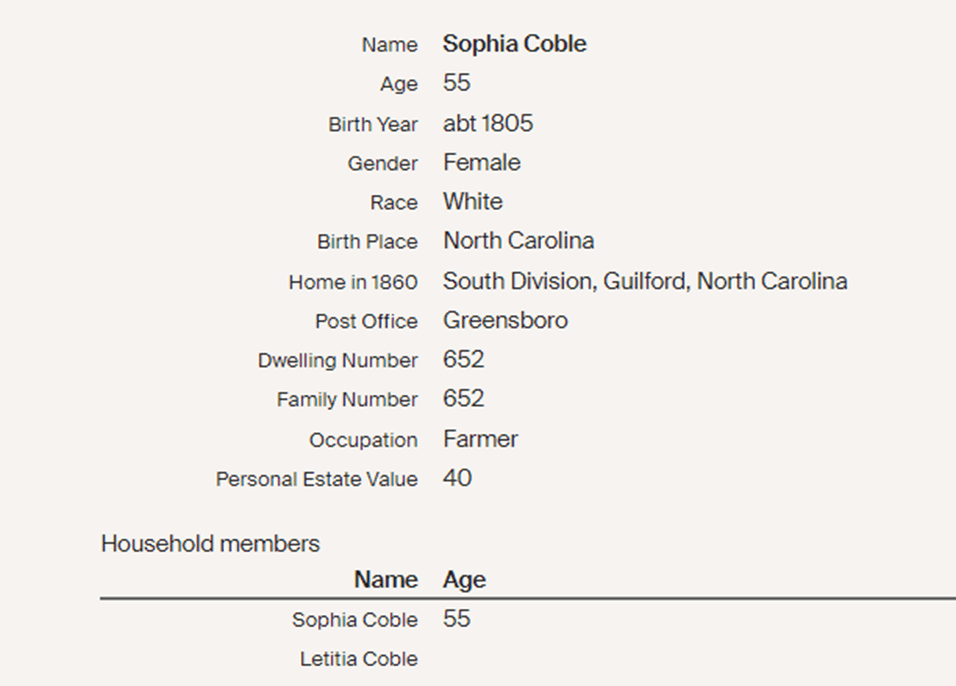
In 1870, a Sophia Coble is living with Alfred Dobson and Webster Dobson in southern Guilford County. The relationship between the three is unknown.[1] Most researchers assume that Sophia is buried with her husband Abram at Coble’s Lutheran Church Cemetery.
[1]Ancestry.Com. Year: 1870; Census Place: Clay, Guilford, North Carolina; Roll: M593_; Page: ; Image: .
Abram Fox Coble and Maria Sophia Hagey Coble were survived by the following children:
- Abner Coble and wife Nancy Ingold
- William M Coble and wife Lucetta Gullette
- Joel George Coble and wife Polly Bishop
- Alfred Coble and wife Charlotte Lottie Allred
- Elias Coble and wife Adeline Long
- John Coble and wife Martha Jane Breedlove
- Delilah Ganeitta Coble‘s first husband was Daniel Breedlove who died in 1863. She married Peter Kinney in 1864. She was later married to John Henry and then to Matthew Woodell
- Letitia Coble’s husband Robert Hanner died in 1872.
Some researchers say Gideon Ambrose Coble 1818-1879 was the son of Abram Fox Coble and Maria Sophia Hagey Coble.[1] I do not believe this is true. I believe his mother and father were Frederick and Sophia Coble because of the age of Gideon and the fact that in the 1860 census, there is a Sophia Coble living in his household who was born in 1795 and would be more of the age to be his mother.
[1] A Genealogy of the Descendants of the Coble’s who settled in North Carolina in the 1700’s by Margorie, Gore, 2021.
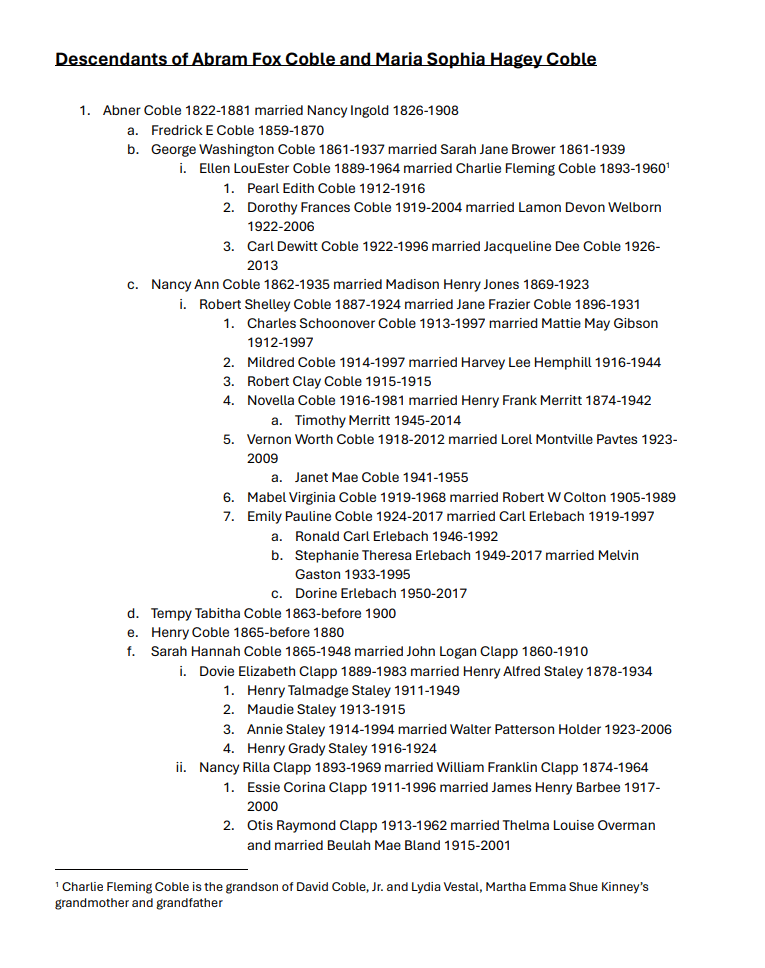
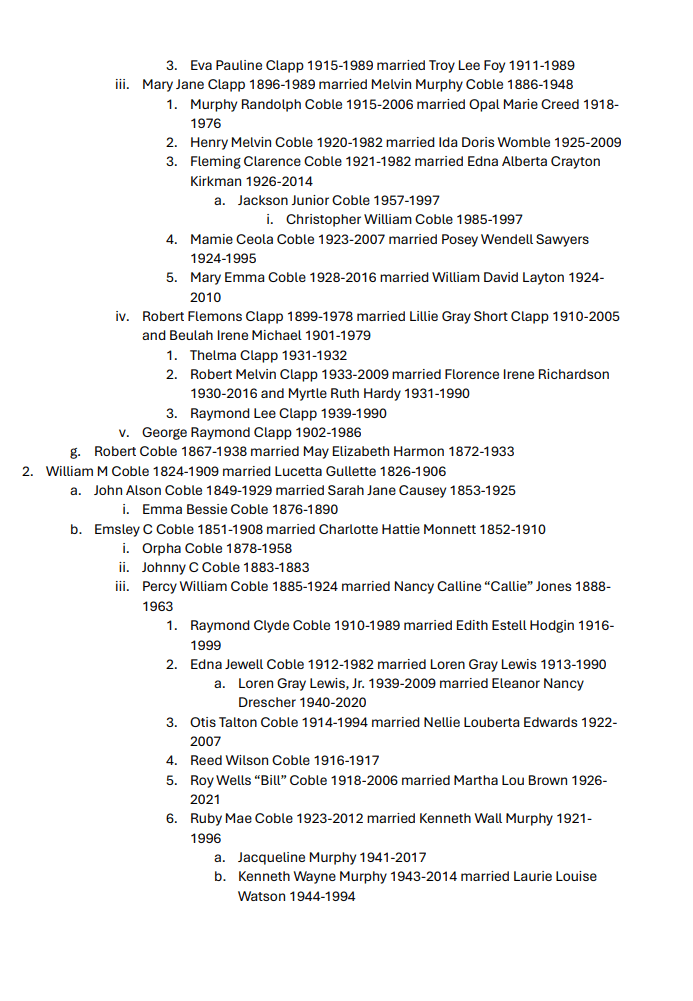
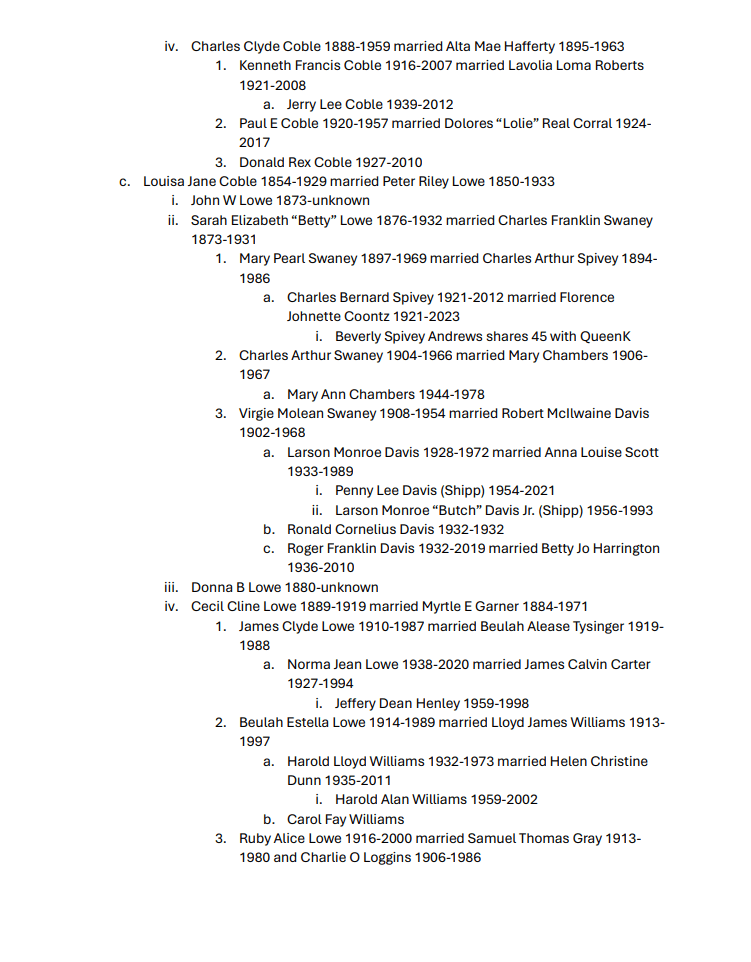
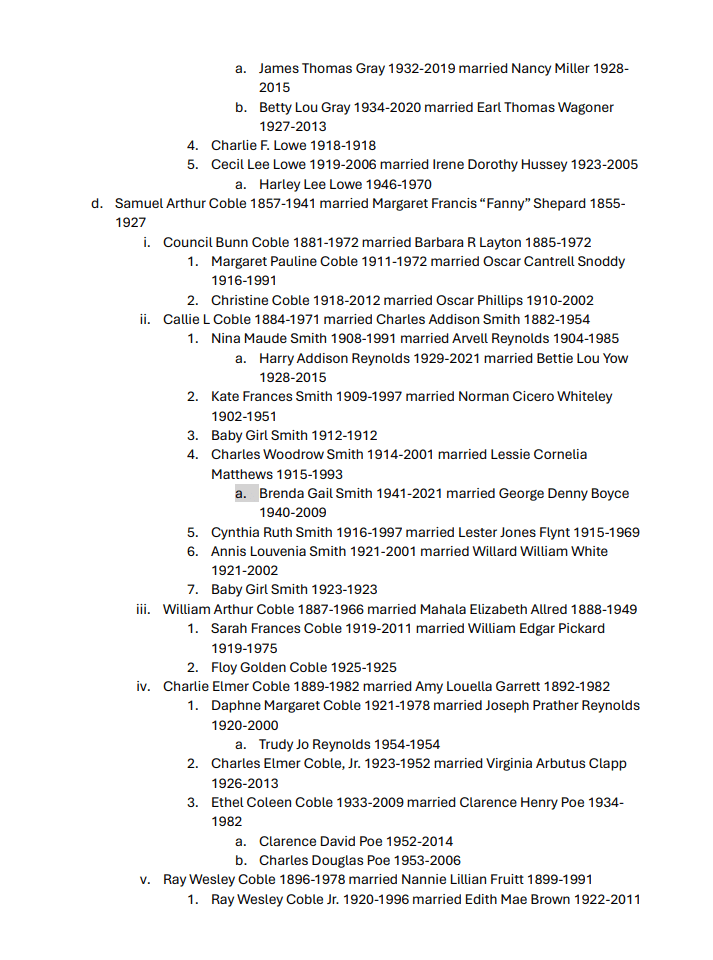
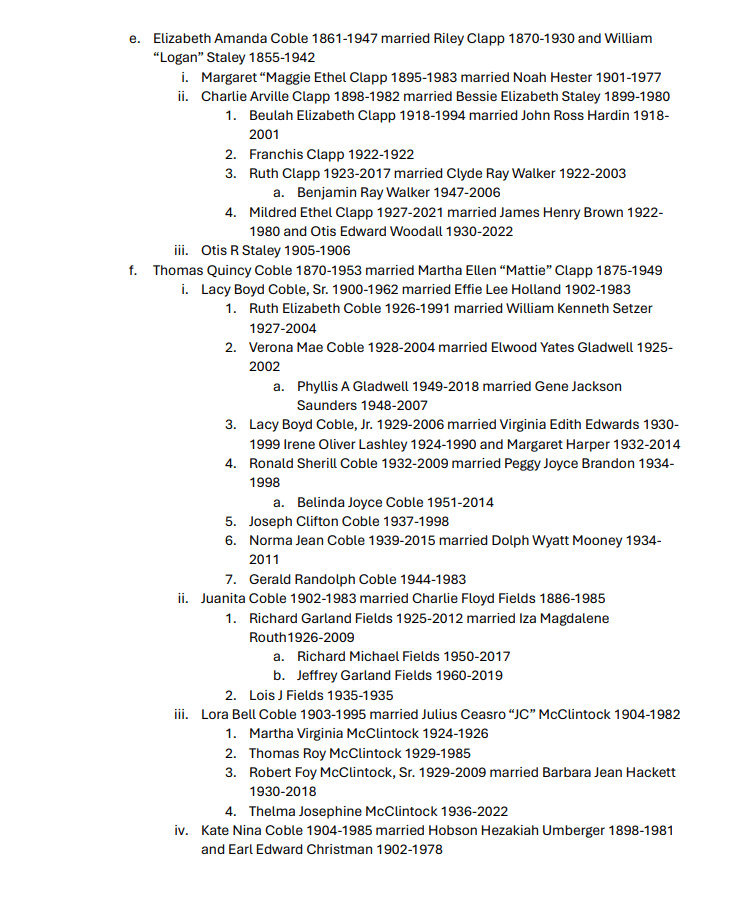
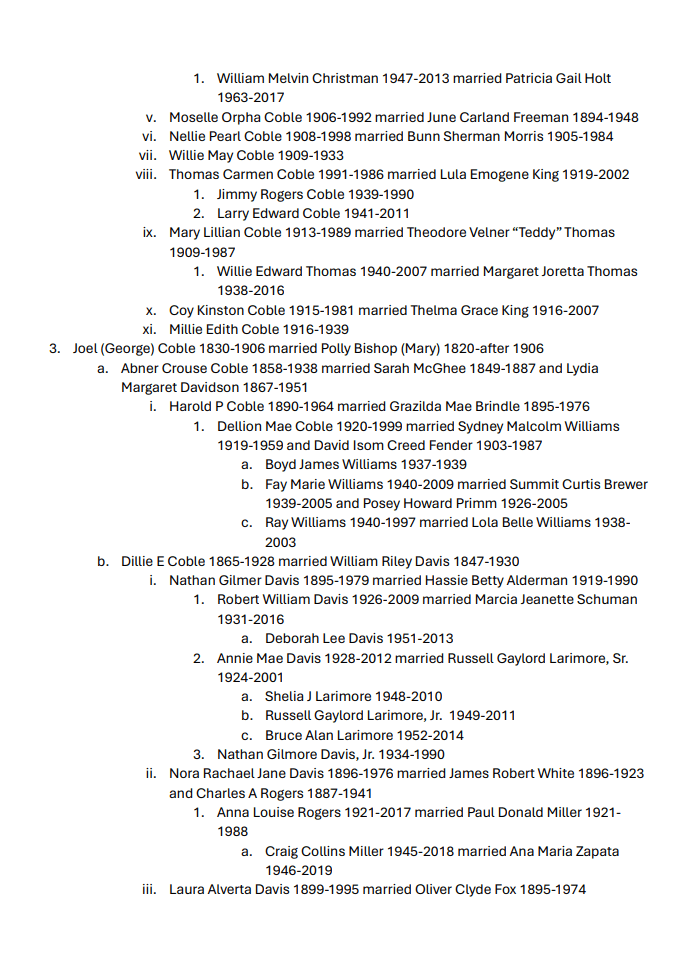
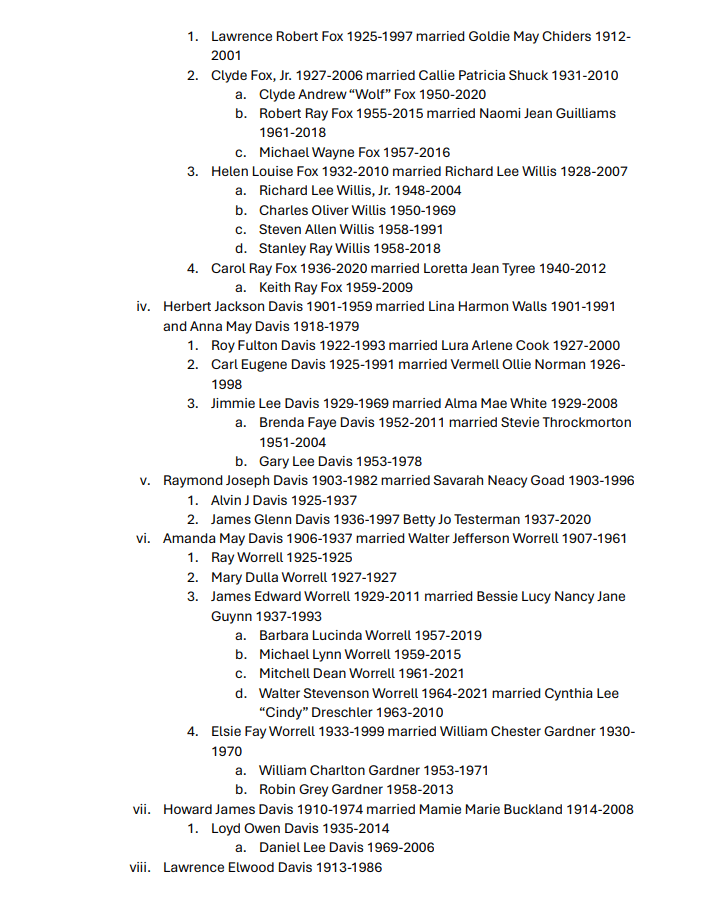
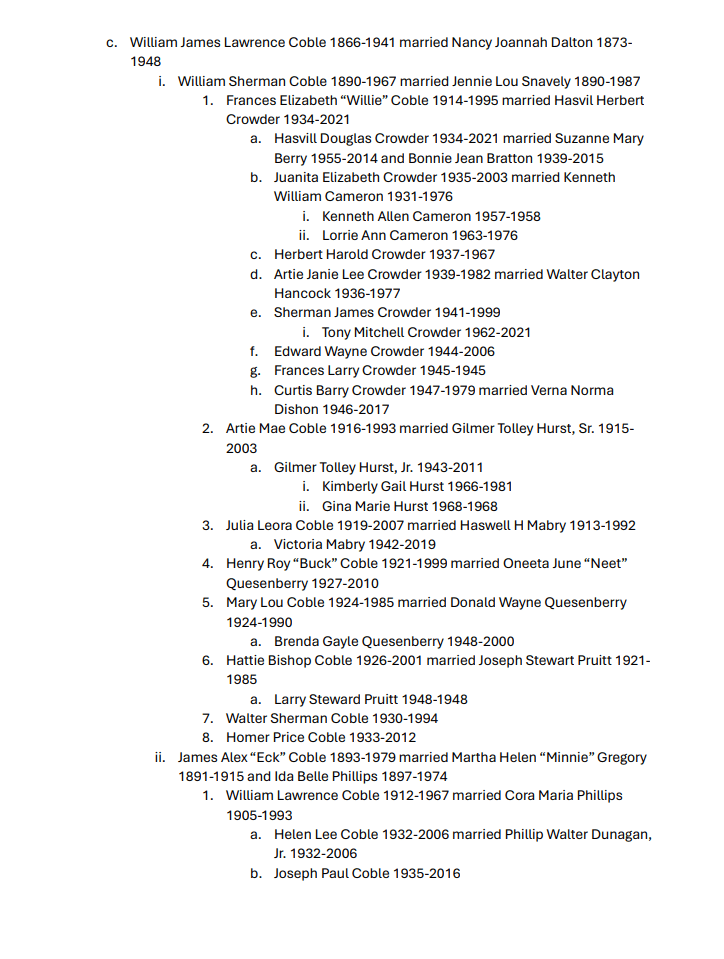

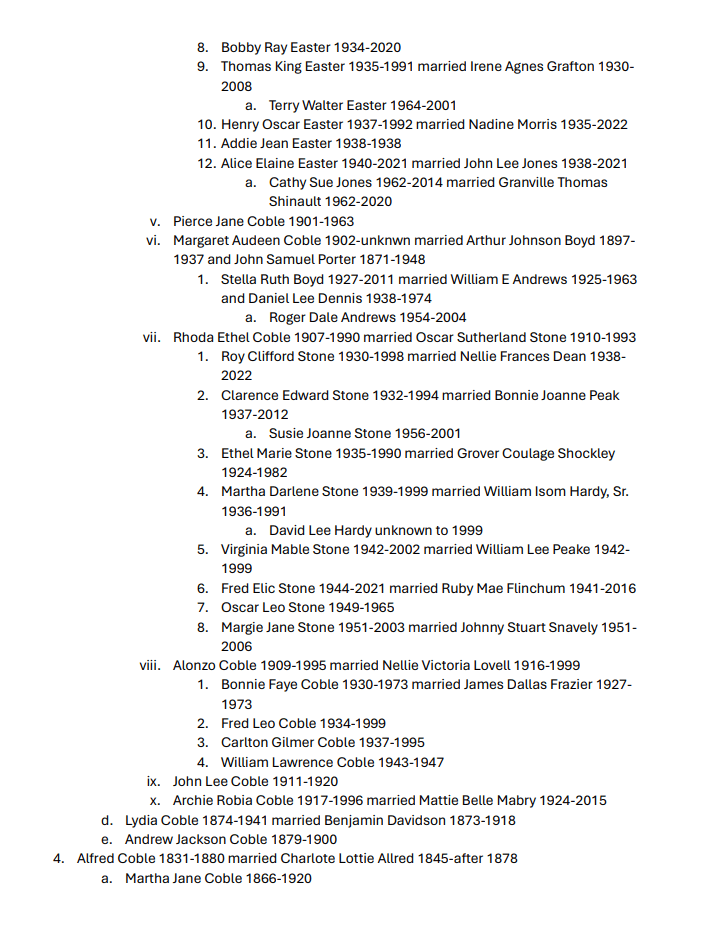
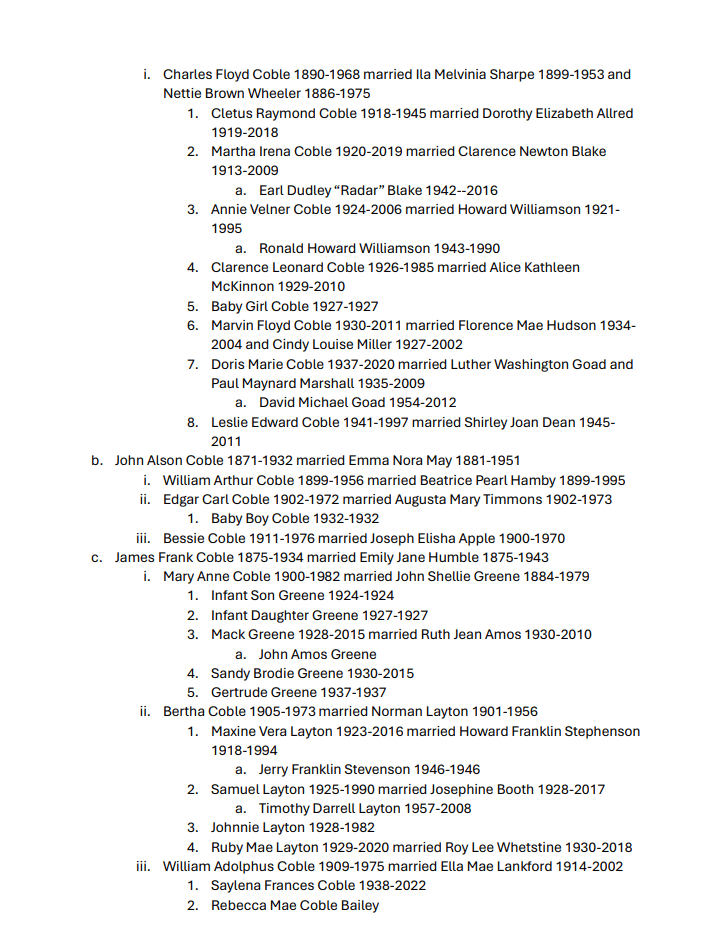
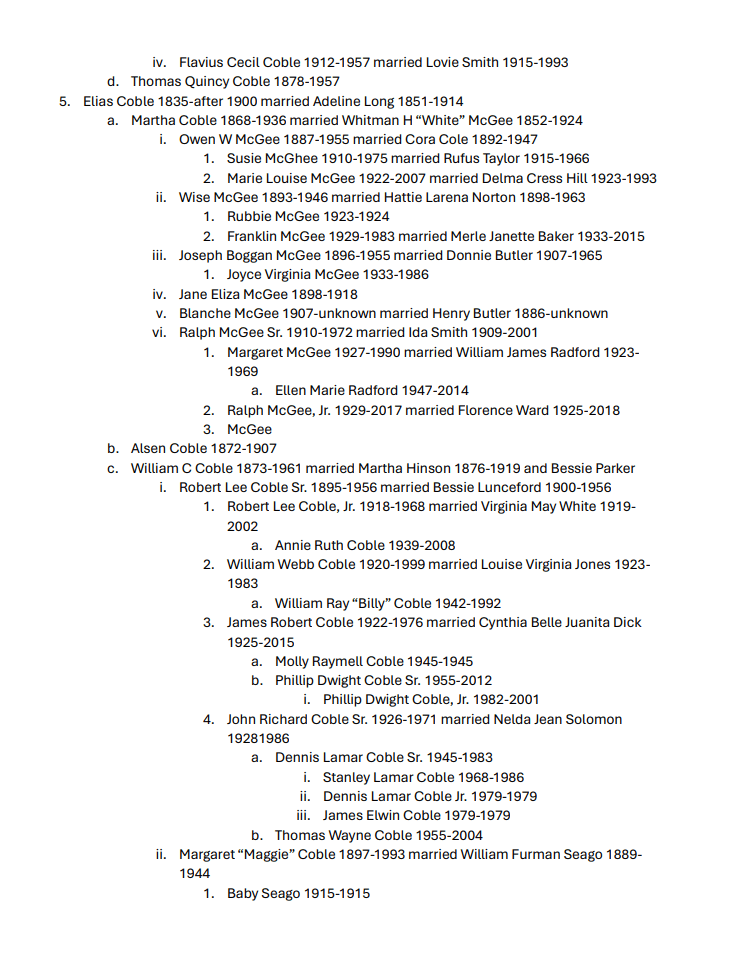
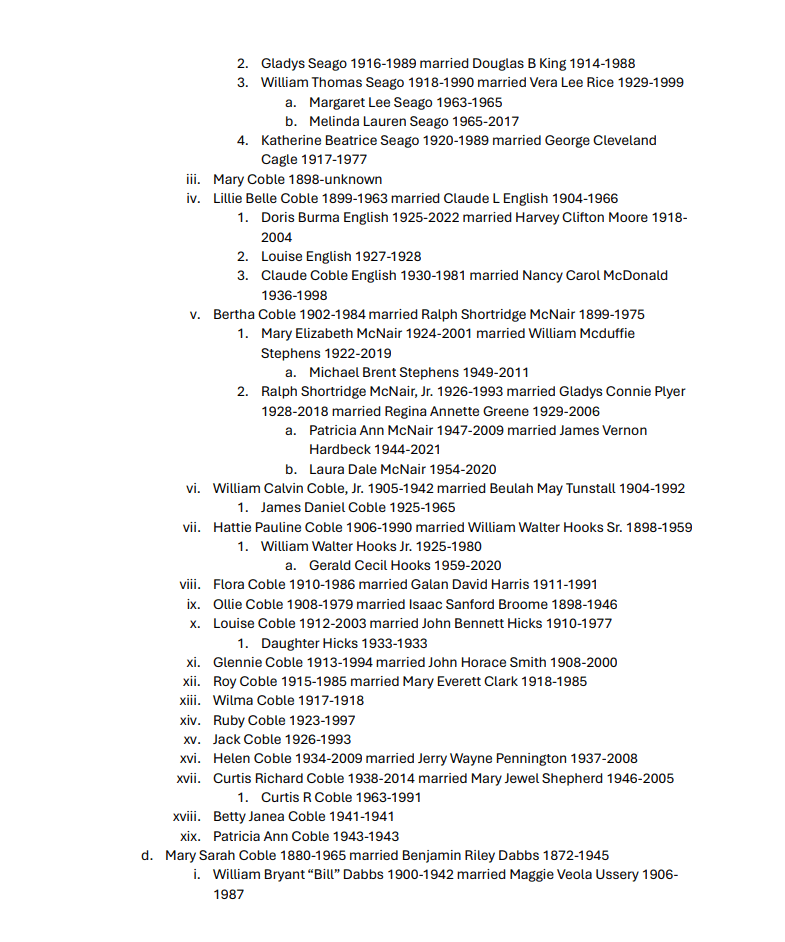

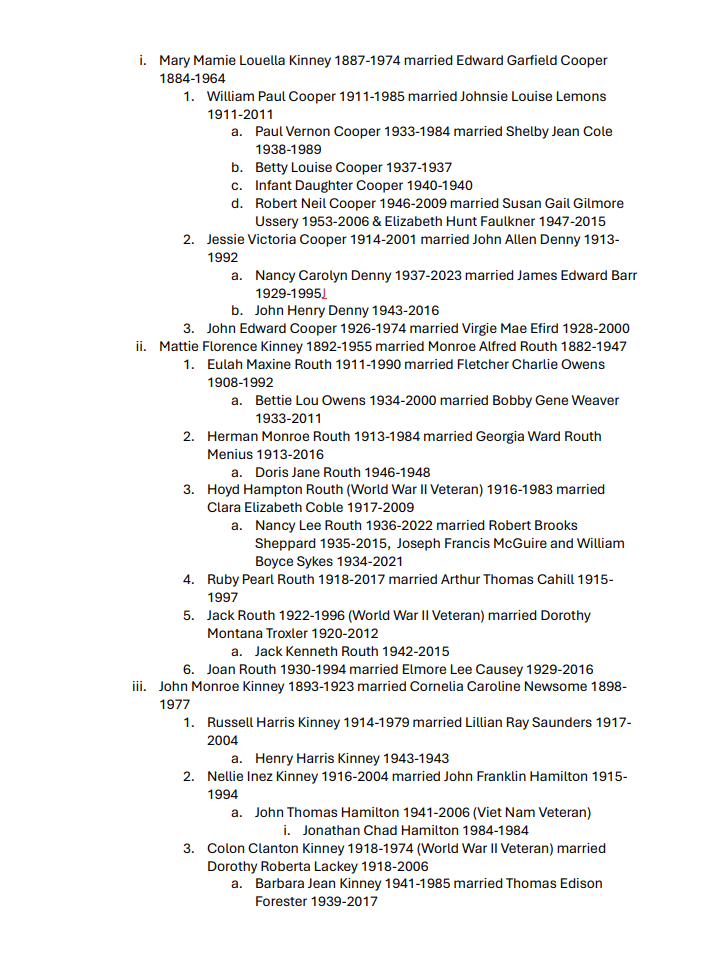
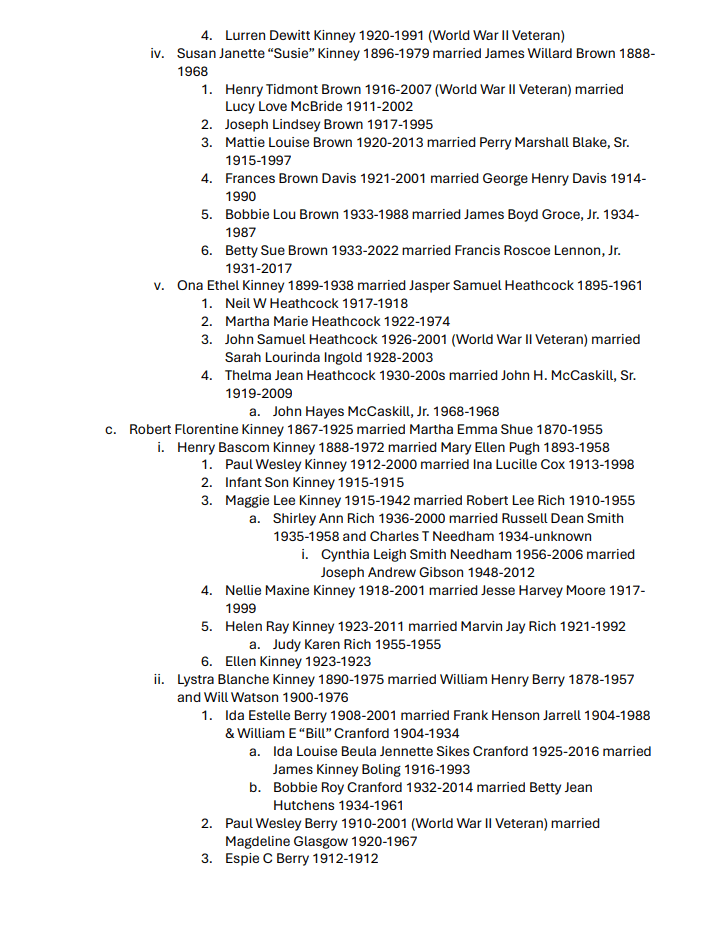
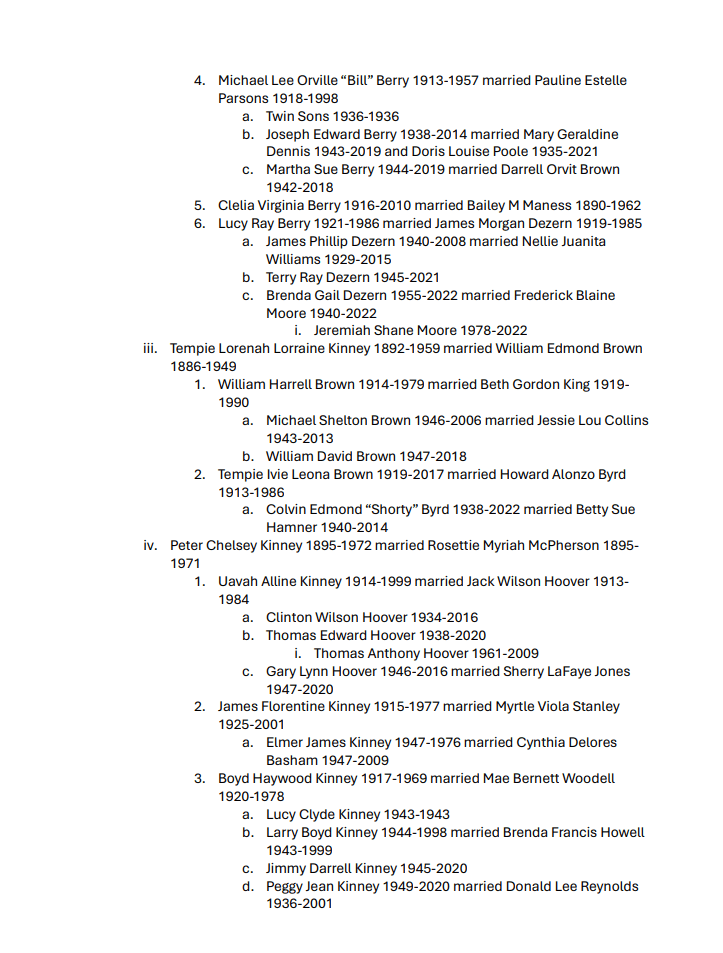
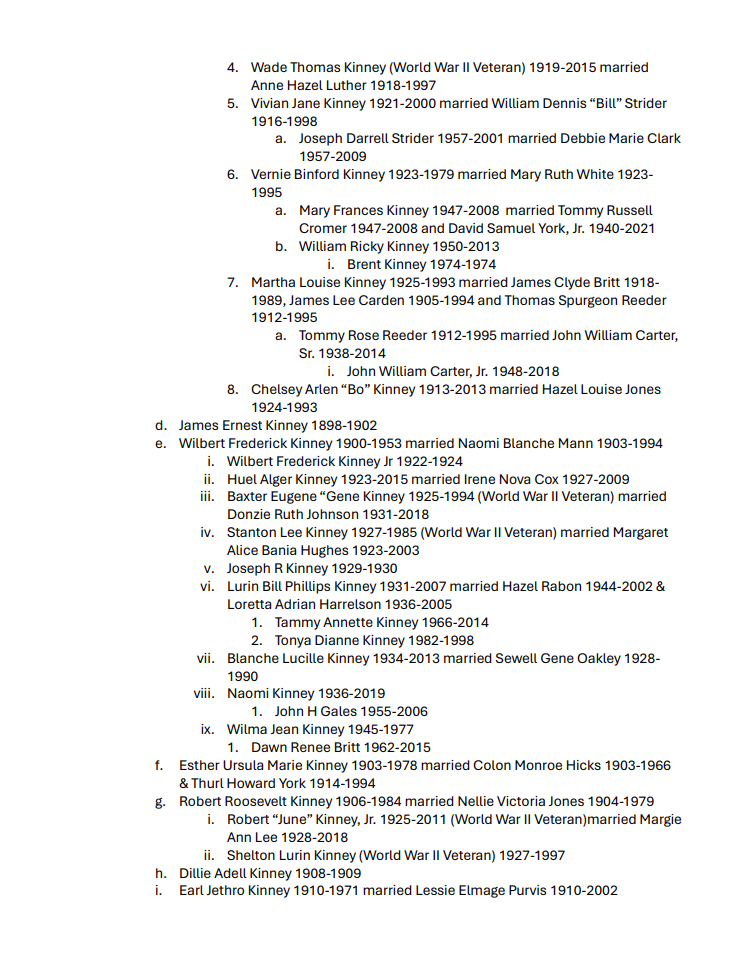

Abram Fox Coble Pedigree
Maria Sophia Hagee Pedigree
Abram Fox Coble’s Parents – Jacob Coble 1768-1857 & Jane Jennie (Christine) Welker 1770-1818
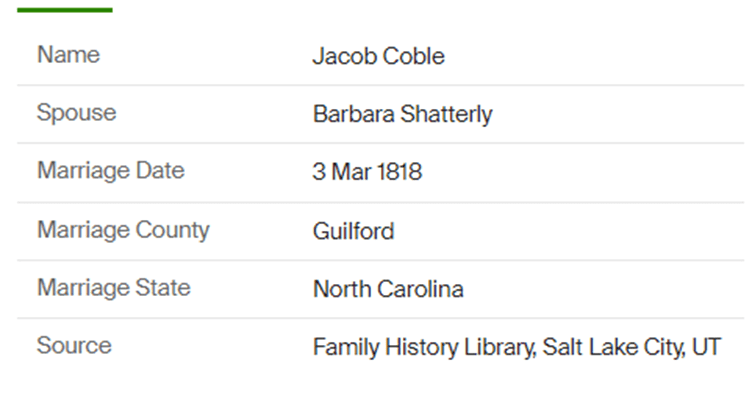
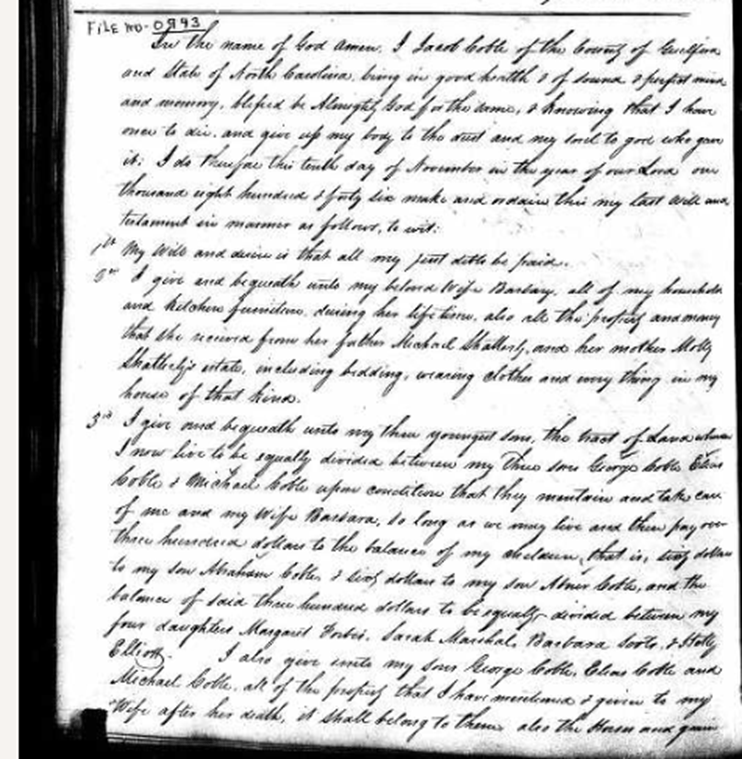
Abram Fox Coble’s mother and father were Jacob Coble and Jane Jennie Welker. Jennie Welker died in 1818 and Jacob married Barbara Shatterly in 1818.[1] Jacob Coble died in 1847 and is buried at Coble Lutheran’s Church.[2] He left a will in which he named his children by Jane as Abram Coble, Abner Coble, Margaret Coble Forbis, Sarah Coble Marshall, Barbara Coble Suits, Hettie Coble Elliott. The three youngest boys were his children with Barbara Shatterly. They were: George, Elias, and Michael Coble.[3] The will has been transcribed by Larry W. Cates and appeared in The Guilford Genealogist, Volume 32, No 1, Spring 2005, Issue 108.
[1] Ancestry.Com. North Carolina Marriage Collection, 1741-2004.
[2] Find A Grave at Jacob Coble (1768-1847) – Find a Grave Memorial accessed February 20, 2024.
[3] Ancestry.Com. North Carolina, U.S., Wills and Probate Records, 1665-1998.
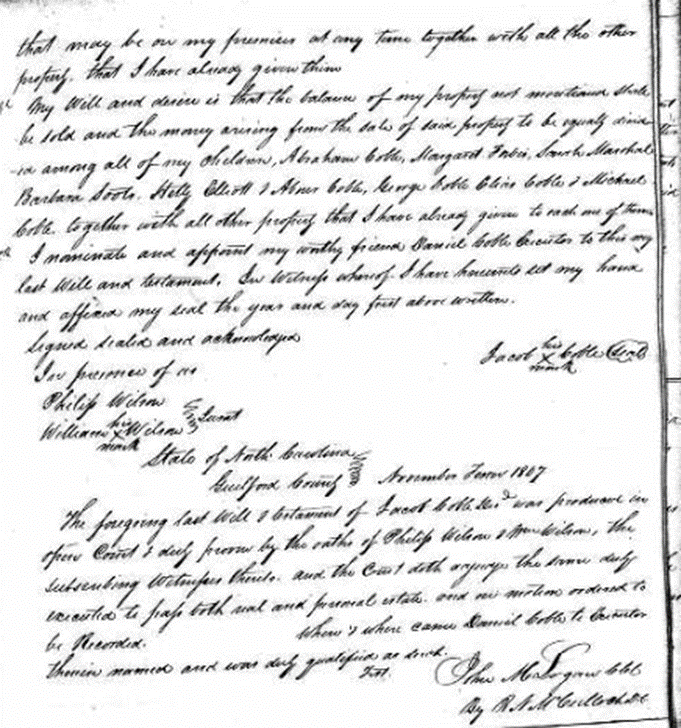
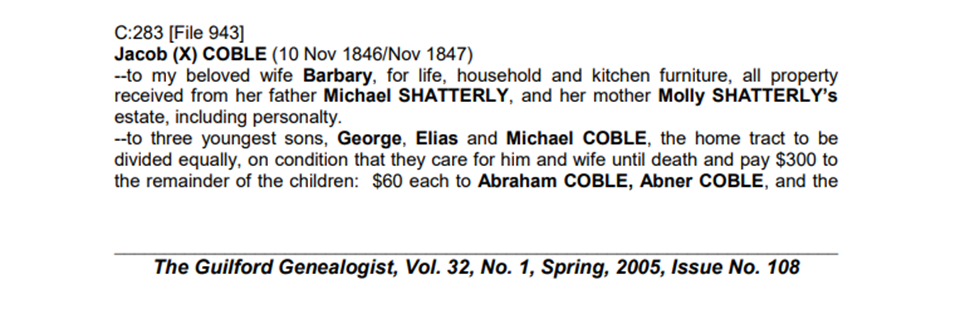

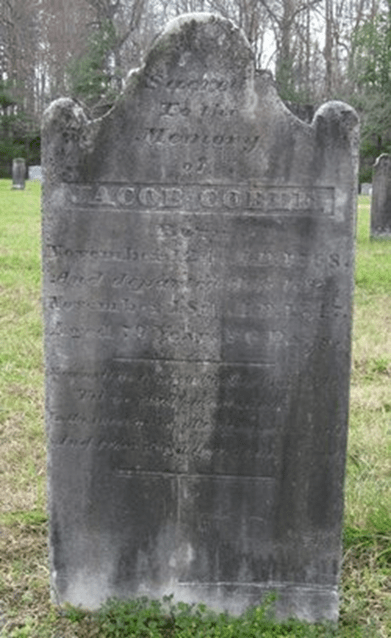
Jane Jennie Welker’s parents were George Welker and perhaps Eva Amick of Guilford County.
Descendants of Abram Fox Coble share Ancestry DNA matches with the descendants of Abner Coble, Margaret Coble Forbis, Sarah Coble Marshall, Barbara Coble Soots (Suits). Hettie Coble and Henry Elliott were married in 1838. They had no known children. There are no matches to the ½ brothers of Abram Coble (George, Elias, and Michael. According to the publication Coble Family Records by the Alamance Historical Society, Elias and Michael never married.
Abram Fox Coble’s Paternal Grand Parents – John George Coble 1733-1816 & Barbara Glass 1735-1816
According to the Coble Record’s Book, Abram Fox Coble’s grandfather was John George Coble who married Barbara Glass. [1] He was born May 10, 1733 in Germany.[2] His parents were John Nicholas Kobel and Dorethea Ernestine Crafts. Jacob’s first entry of land purchase in North Carolina in 1762.[3] George Coble’s wife Barbara was also most likely born in Germany. They were married around 1757. Barbara’s parents were: John Phillip Gleiss Glass & Anna Maria Coble?
[1] Coble family records (familysearch.org) accessed February 20, 2024.
[2] Geneanet Community Trees Index/i. Paris, France: Geneanet.
[3] Coble family records (familysearch.org) accessed February 20, 2024.

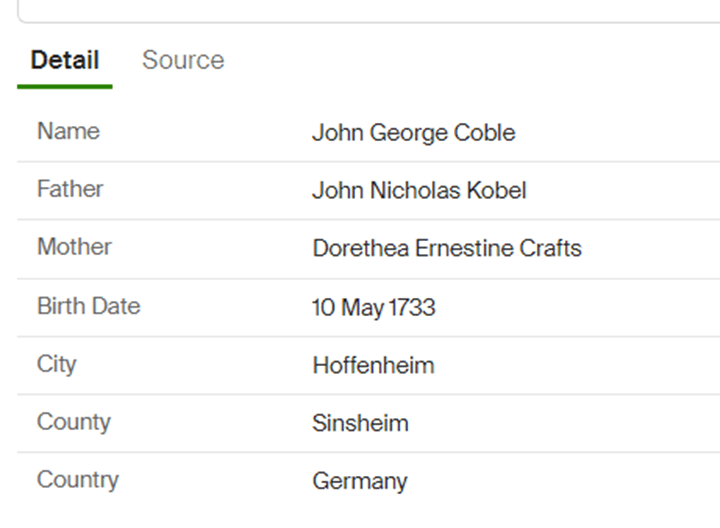
George Coble is a Revolutionary War Patriot. He appears in the Revolutionary Army Accounts and was paid for services rendered.[1]
[1] DAR Genealogical Research Databases accessed February 20, 2024.
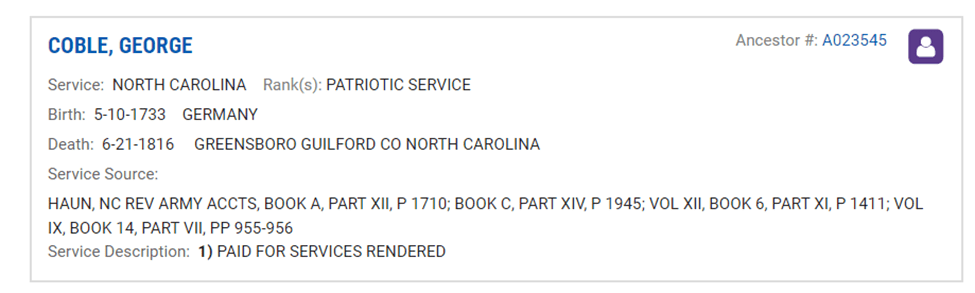
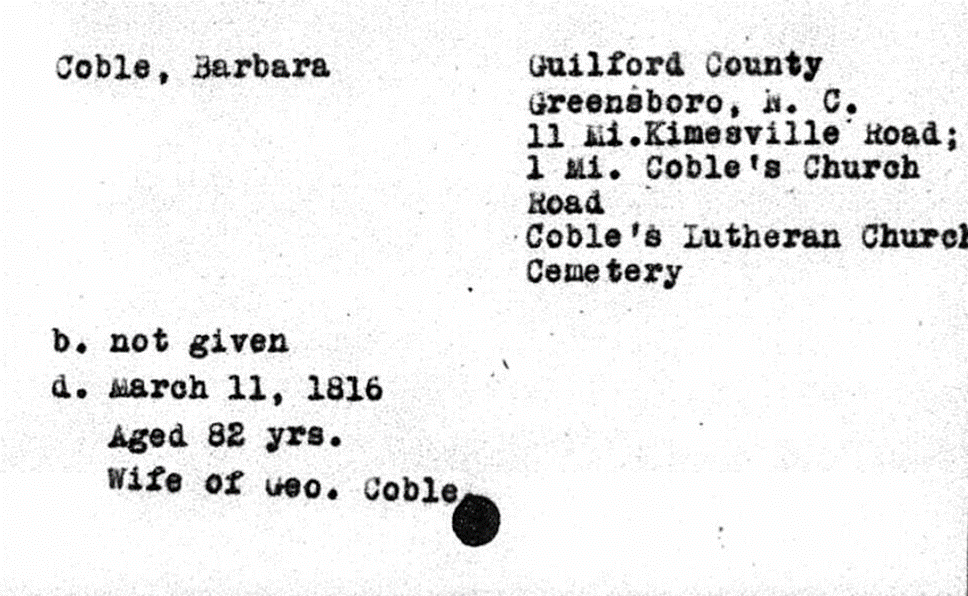
George died in June 1816[1] and was buried at Cobles Lutheran Church in Julian, North Carolina. The DAR has also placed a monument there. [2] Records state that Barbara died in March 1816[3] as well and was buried with her husband at Cobles Lutheran.[4]
[1] Ancestry.Com. North Carolina, U.S., Historical Records Survey, Cemetery Inscription Card Index, 1700-2018.
[2] Find A Grave at Johann “George” Coble (1733-1816) – Find a Grave Memorial accessed February 20, 2024.
[3]North Carolina, Historical Records Survey, Cemetery Inscription Card Index, 1700-2018
[4] Find A Grave at Maria Barbara Glass Coble (1735-1816) – Find a Grave Memorial accessed February 20, 2024.

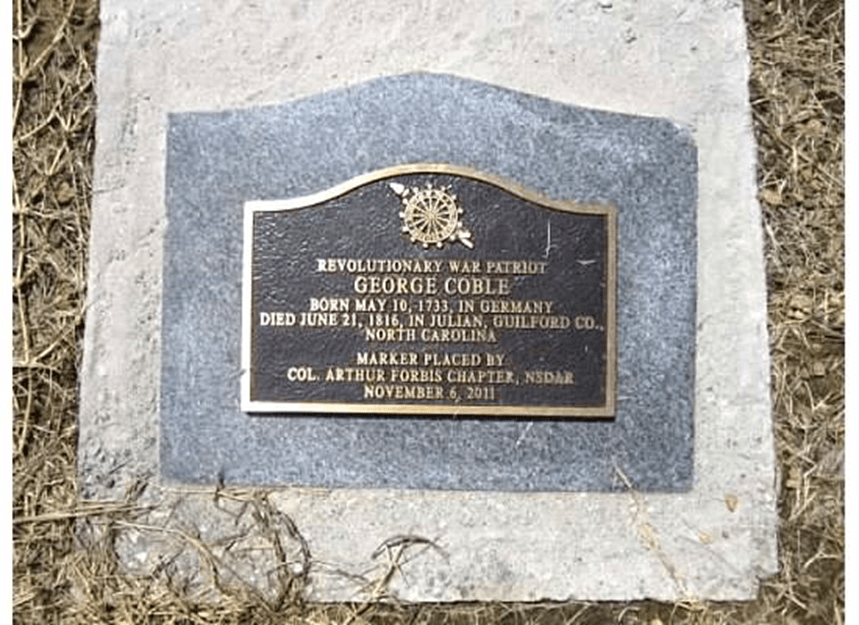
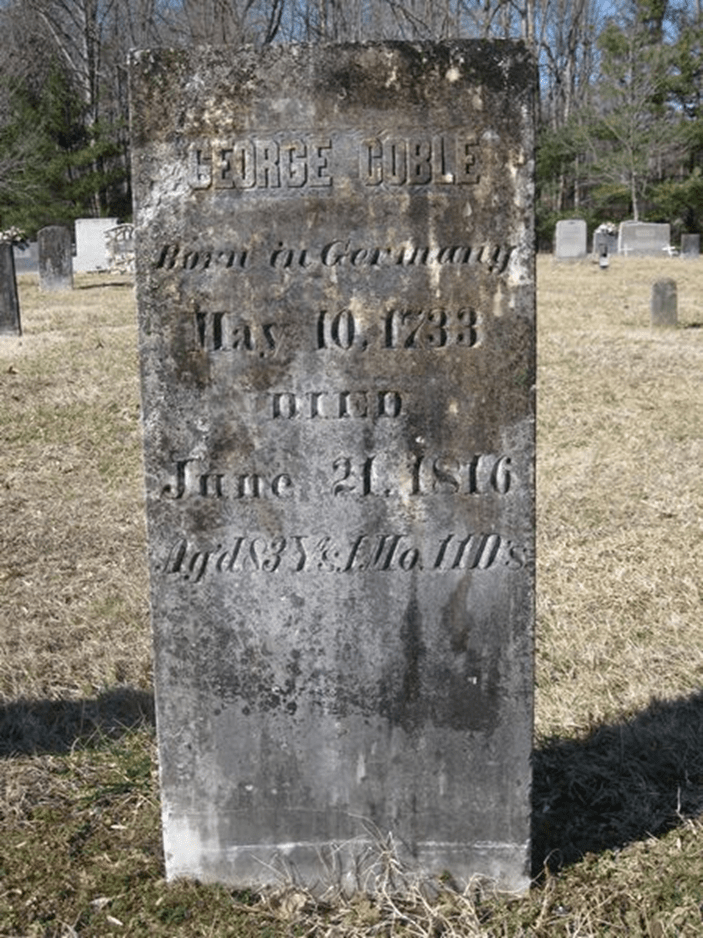
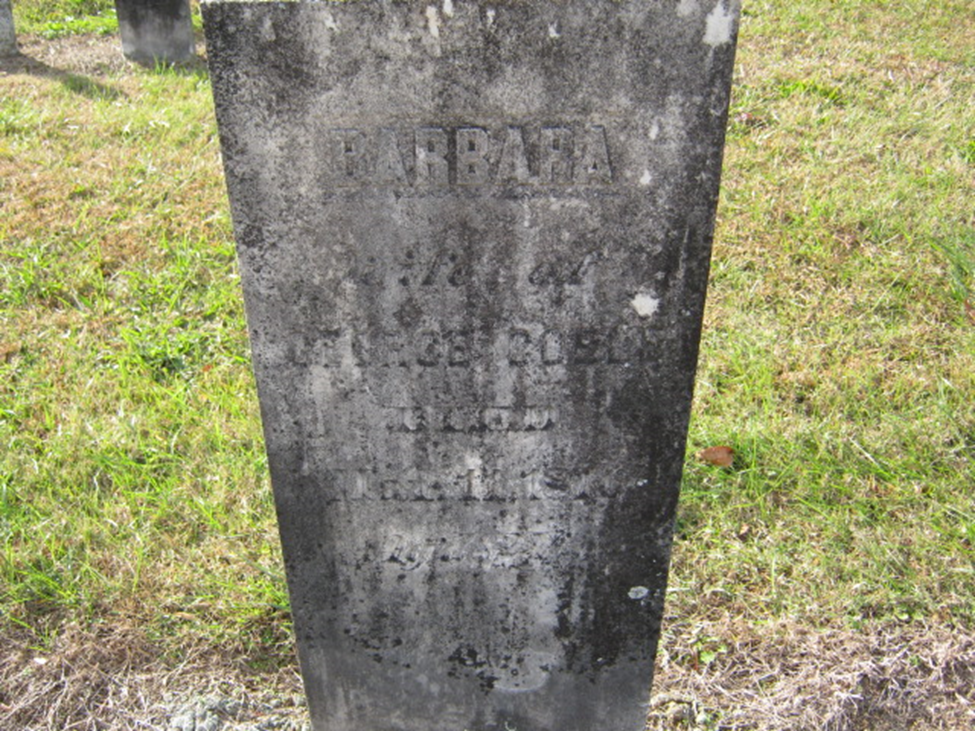


Children mentioned in George Coble’s will in 1816 were: sons: Phillip, Paul, Jacob, Peter, Frederick, Nicholas, and daughter Mary Coble.[1]
[1] North Carolina Probate Records, 1735-1970; https://familysearch.org/ark:/61903/3:1:939L-V1SN-CC?cc=1867501&wc=32L2-829%3A169767301%2C170821601 accessed February 20, 2024.
Son Phillip had a will when he died in 1842. Children mentioned in the will include George Coble, Barbara Wilson (Peter Wilson), Frederick Coble, John Coble, Conrad Coble, and Mary McClintock (John M). Descendants of Phillip share Ancestry DNA with Descendants of Abram Fox Coble.[1]
[1] Ancestry.Com. North Carolina, U.S., Wills and Probate Records, 1665-1998.
Paul (Powell) Coble left a will when he died in 1846.[1] Children mentioned in the will include William, George, Jacob, Peter, Miriam, Paul, David and Daniel. Martha Rogers and Queen K share Ancestry DNA matches with descendants of Paul and his brothers Peter and Frederick:
[1] Ancestry.Com. North Carolina, U.S., Wills and Probate Records, 1665-1998.
Abram Fox Coble’s Maternal Grand Parents – George Welker 1750-1810 and Eva Barbara Amick 1767-1810
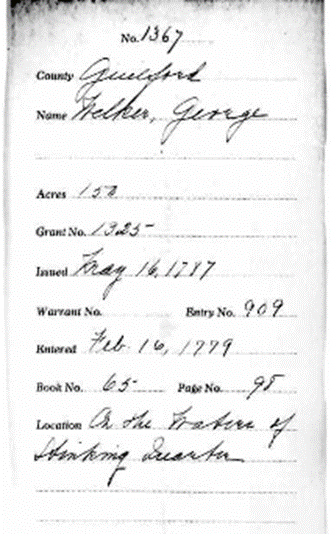
George Welker purchased property on Stinking Creek in February 1783. He purchased land 150 acres of land from Benjamin Jones for 30 pounds.[1] George Welker also got a land grant in Guilford County in 1779 for 150 acres on the waters of Stinking Creek.[2] George Welker was married to the daughter of Nicholas Amick and Eva Margaretha Rausch. Some researchers say her name was Eva but offer no proof.
[1] The Guilford Genealogists, Vol 32, No. 2 Summer, 2005, Issue 109, “The “Other” Welkers of Brick Church (Reformed) Community” by Larry W Cates
[2] North Carolina Land Grants. Microfilm publication, 770 rolls. North Carolina State Archives, Raleigh, North Carolina.
This is a list of George Welker’s Children from the Guilford Genealogist[1] Descendants of Christina Welker (Jennie) share Ancestry DNA with descendants of Maria Peggy Welker Greeson.
[1] The Guilford Genealogist, Volume 109, page 49.
- George Welker 1770-1847 married Anna Maria ? and Molly Staley
- Christina Welker (Jennie) 1770-1775-unknown married Jacob Coble
- Anna Margaret Welker married David Coble died 1827
- Catherine Welker 1760-1830-1840 married Henry Coble (unknown-1826)
- Magdalena Welker 1775-80 – 1820-1830 married Adam Low
- Maria Peggy Welker 1770-80 – unknown married David Greeson 1770-80 – 1821
- Elizabeth Welker 1772-1845 married Henry Kimmery
- female Welker married John Randolph
- Barbara Welker 1785-1790 – unknown married Lewis Ludwig Clapp 1785-1850-1860
- Jacob Welker 1790/1800-1844 married Elizabeth
Coble Family
Abram Fox Coble’s grandparents were Johann Nicolas Kobel (Gobel) and Dorothea Emstine Krafts. According to Wikitree,[1] Johann Nicolas died on February 22, 1765 at the age 0f 63 in Hoffenheim, Sinsheim, Baden, Germany.[2] According to Wikitree, Dorothea died on January 31, 1781 at age 73 in Hoffenheim as well.[3]
[1] Johann Nicholas (Kobel) Coble (1701-1765) | WikiTree FREE Family Tree.
[2]Johann Nicholas Kobel (1701-1765) – Find a Grave Memorial accessed December 20. 2023.
[3] Anna Dorothea (Krafft) Coble (bef.1707-1781) | WikiTree FREE Family Tree.

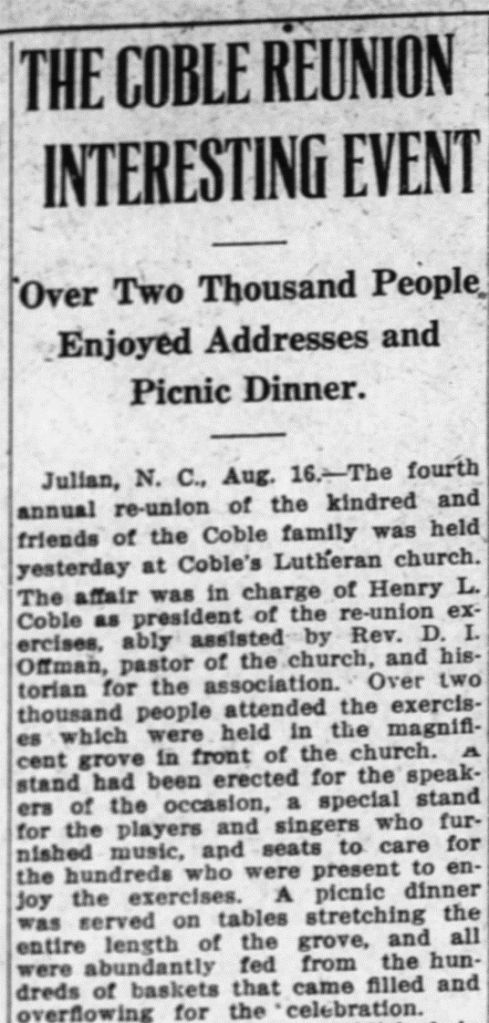
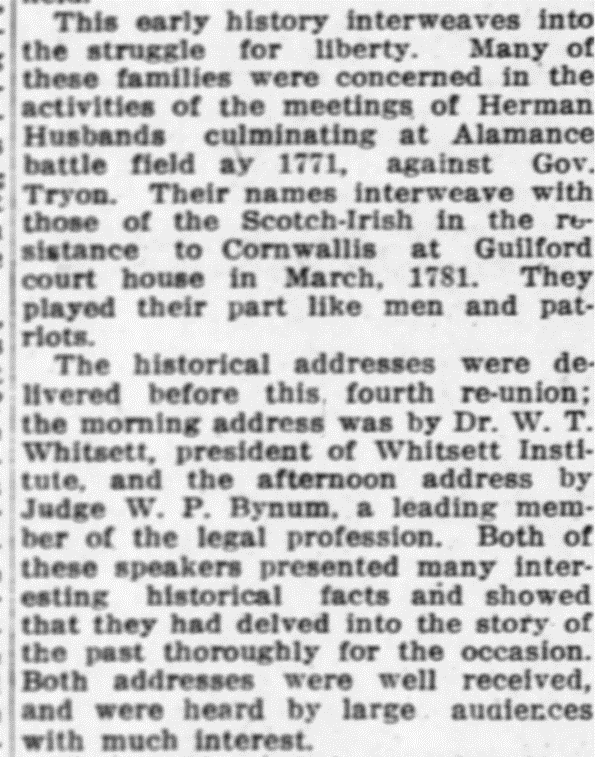
The Coble family is a large family in Southern Guilford County and the surrounding counties of Randolph and Alamance. This newspaper article details their history.[1]
[1] Newspapers.com – Everything – 1917-08-25 – Coble Reunion.

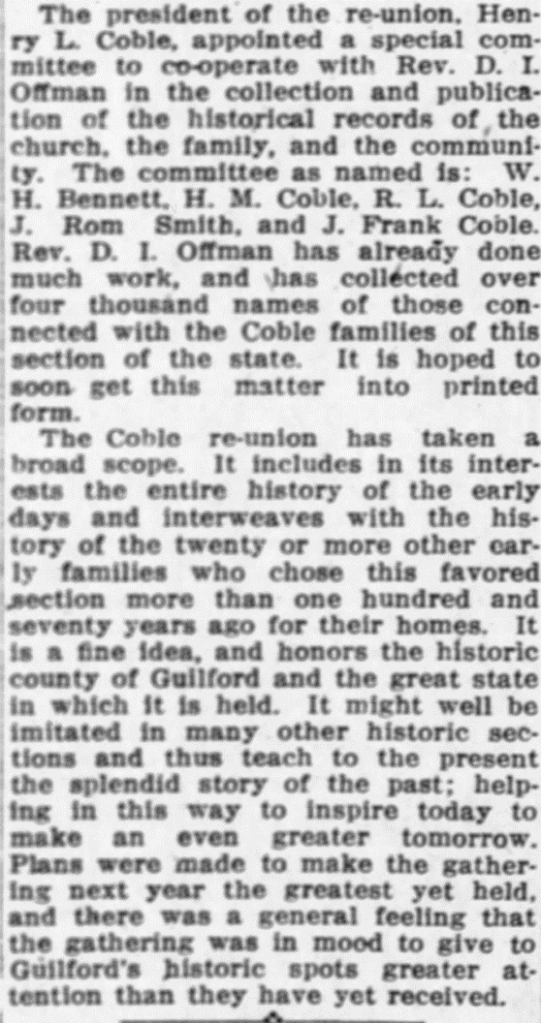
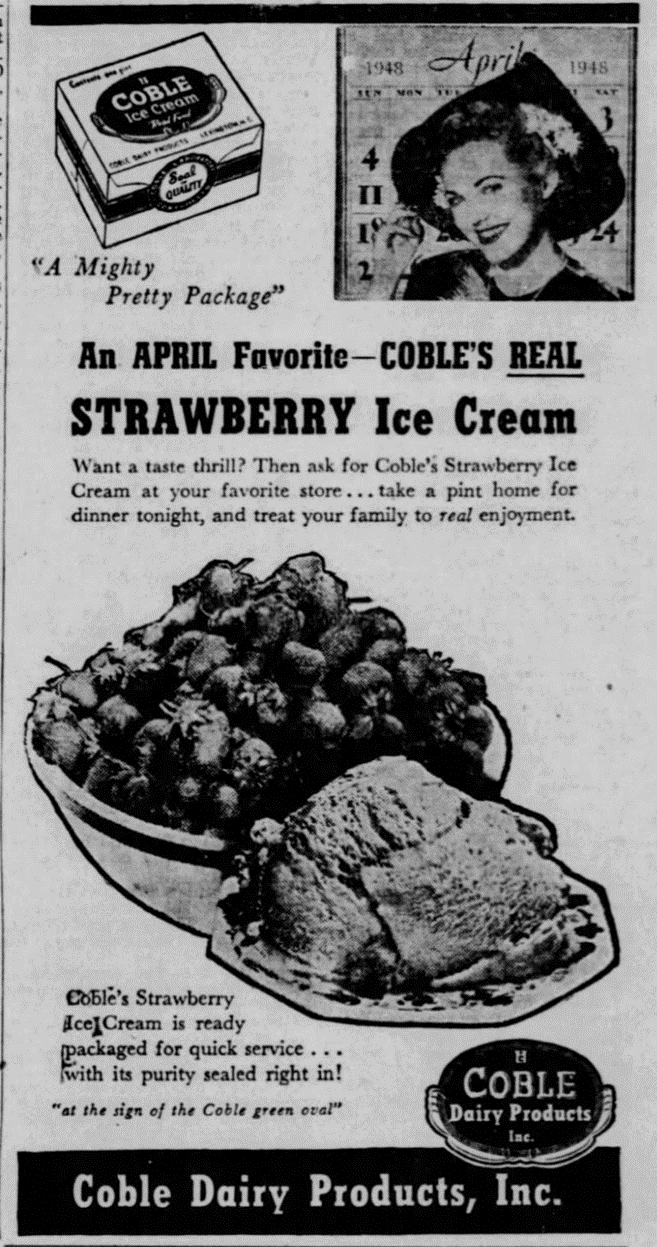
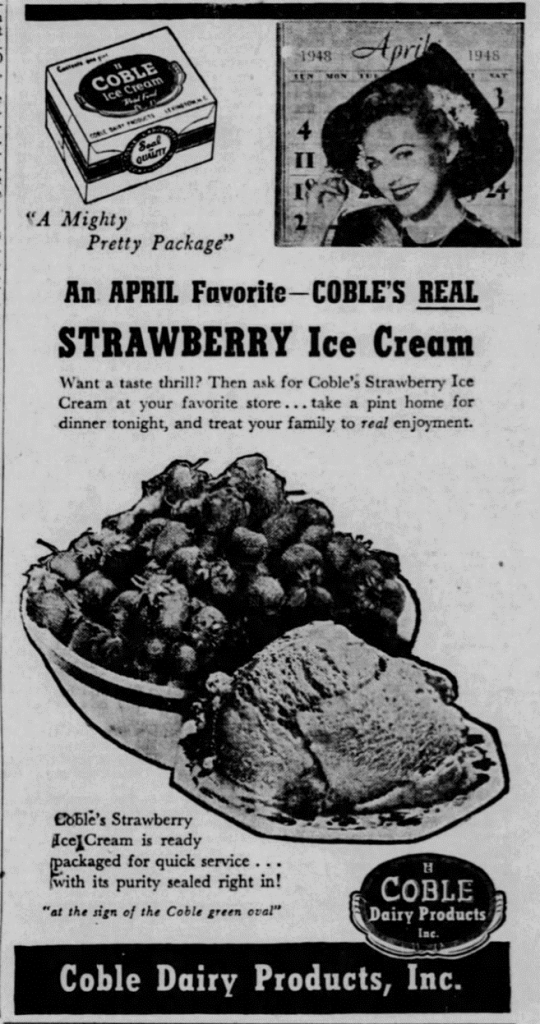
The Cobles are also well known for Coble Dairy Products.[1]
[1]Newspapers.com – The Greensboro Record – 3 Apr 1948 – Page 2.
There is a YDNA project for Cobles (Kobel, Cobel). One group goes back to Johann George Kobel who was born in 1655 in Nordingen Germany and died in Hoffenheim, Sinsheim, Germany. This man had three sons who emigrated to America. YDNA testing of male Cobles could prove whether the Cobles who came to North Carolina and Guilford County descended from John George Kobel or not.[1]
[1] Kobel-Coble – Overview | FamilyTreeDNA accessed February 20, 2024.
Marjorie Gore in her book A Genealogy of the Descendants of the Coble’s who settled in North Carolina in the 1700’s list the following Coble pioneers.
- Albecht Kobel
- Antonius “Anthony Coble” Kobel
- Hans George “George” Kobel
- John Jacob Coble
- John George Coble
- Johannes “John” Coble
- George Adam Coble
- Adam Coble
- Peter Coble
- Frank Coble
- Cornelius Coble
- Adam Coble
- William Jackson “Jack” Coble
This table shows how our family descends from the early North Carolina Coble pioneers.
| John George Coble 1733-1816 | George Adam Coble 1727-1794 | George Adam Coble 1727-1794 | George Adam Coble 1727-1794 |
| Jacob Coble 1768-1847 | Peter Coble 1755-1815 | Peter Coble 1755-1815 | Peter Coble 1755-1814 |
| Abram Fox Coble 1798-1847 | David Coble 1781-1814 | Elizabeth Coble Shue 1792-1830 | Peter Coble 1796 |
| Delilah Ganeitta Coble Breedlove Henry Kinney Woodell | David Coble Jr 1806-1887 | Phillip Shue 1811-1862 | Jeremiah Coble 1842-1929 |
| Robert Florentine Kinney | Temperance Coble Shue 1846-1924 | Peter Shue 1841-1900 | Jeremiah Coble 1872-1948 |
| Robert Roosevelt Kinney | Martha Emma Shue 1870-1955 | Martha Emma Shue 1870-1955 | Roy Earl Coble 1915-2006 |
| Robert June Kinney | Robert Roosevelt Kinney | Robert Roosevelt Kinney | |
| Robert June Kinney | Robert June Kinney |
According to family history, George Adam Coble came straight from Germany to North Carolina with his four children. He settled in Guilford County where he owned considerable land. Three of our family’s Coble lines go back to George Adam Coble while one goes back to John George Coble.
Glass Family
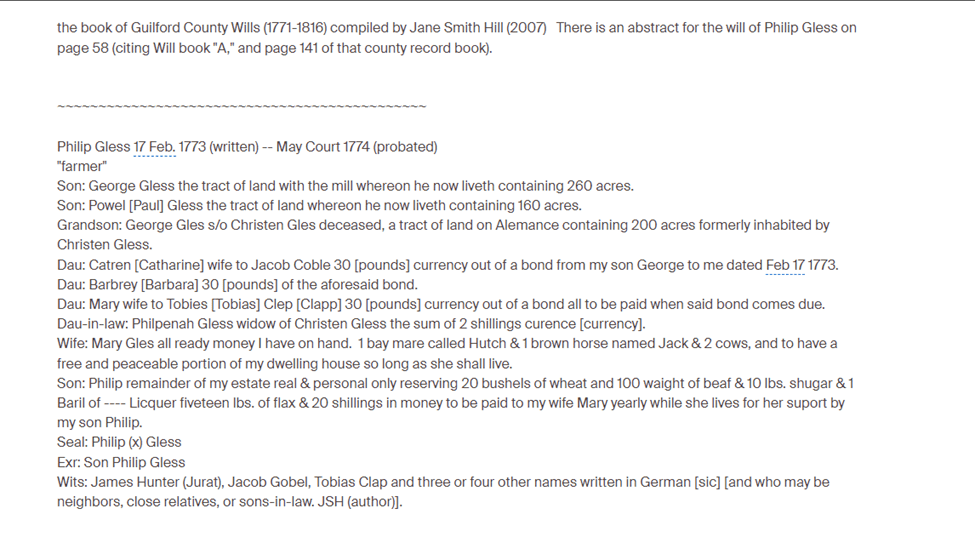
John Phillip Gleiss Glass was born in Germany around 1712. He arrived in Pennsylvania around 1730 and was in North Carolina around 1760. He passed away in Guilford County in 1773 according to Wikitree.[1] There was a will which was probated in 1774[2]. In it he mentions seven children. Four of the seven intermarried with Cobles. Researchers say that John Phillip Glass was married to Anna Kobel or Anna Lentz. DNA matches were observed from descendants of George, Jacob, Paul, Catherine, Christian and Phillip.
[1]John Philip Gleiss (abt.1712-1773) | WikiTree FREE Family Tree accessed February 20, 2024.
[2] Abstract of Philip’s will (ancestry.com) accessed February 20, 2024.
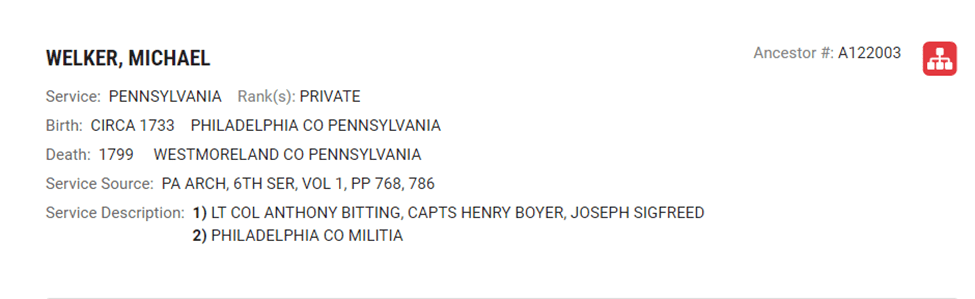
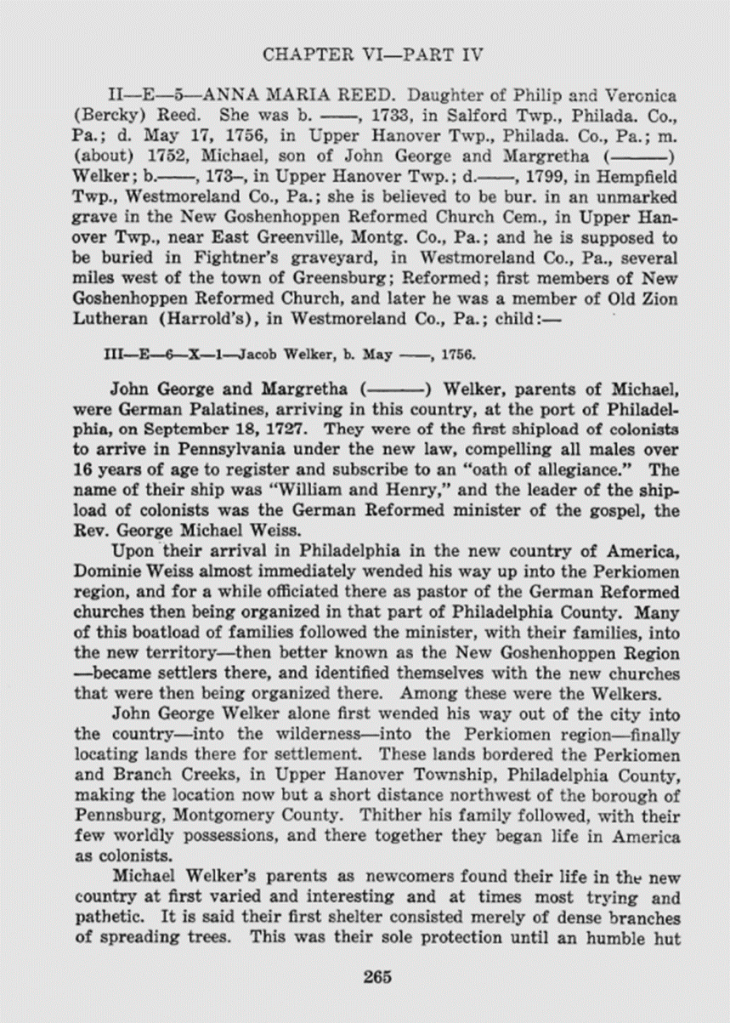
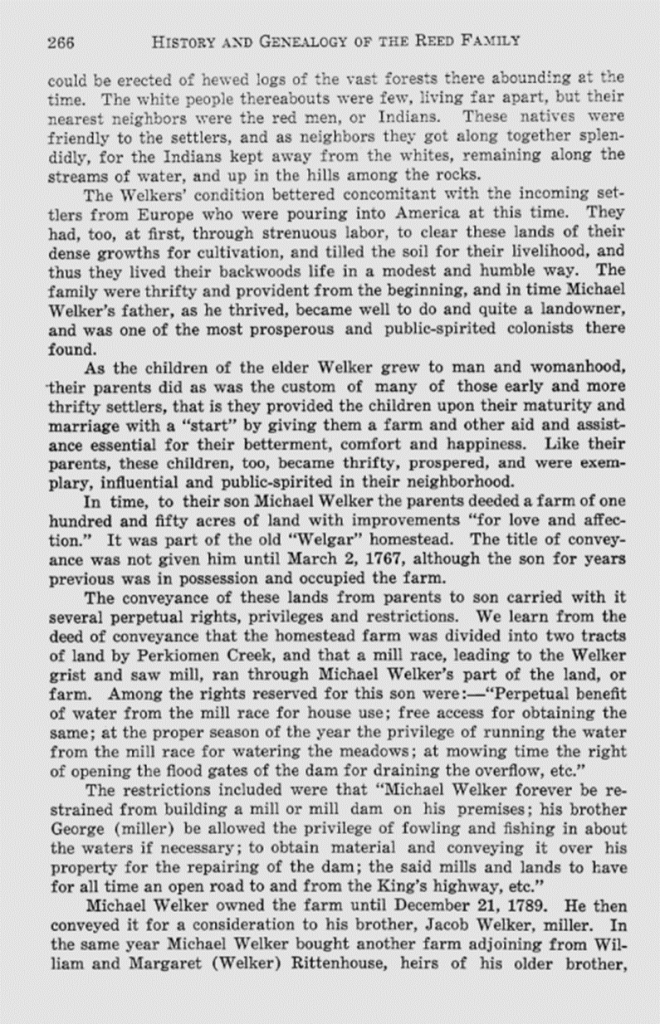
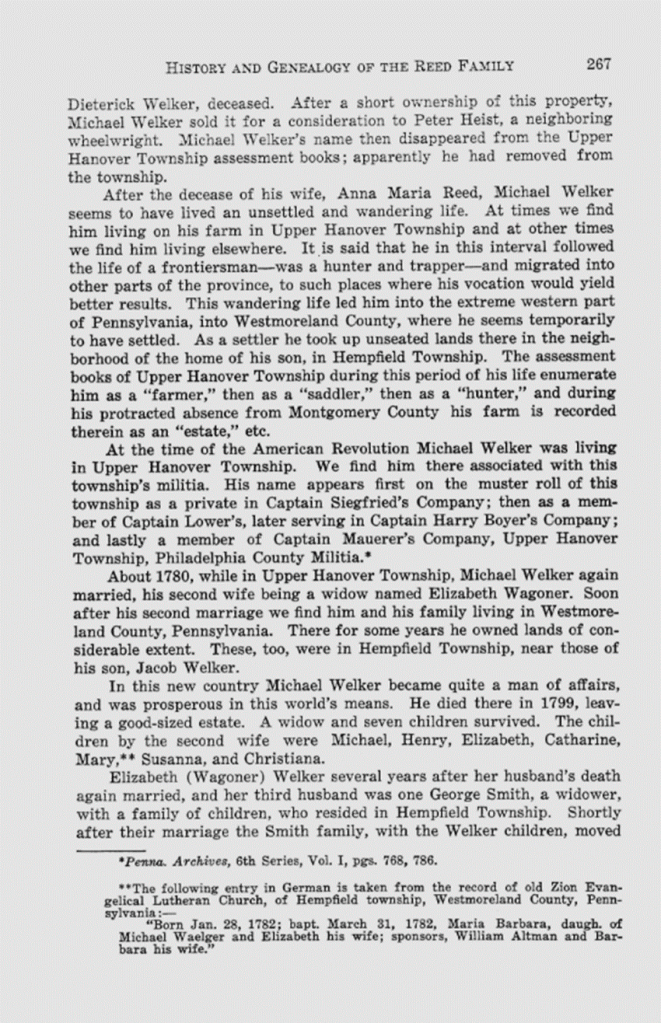
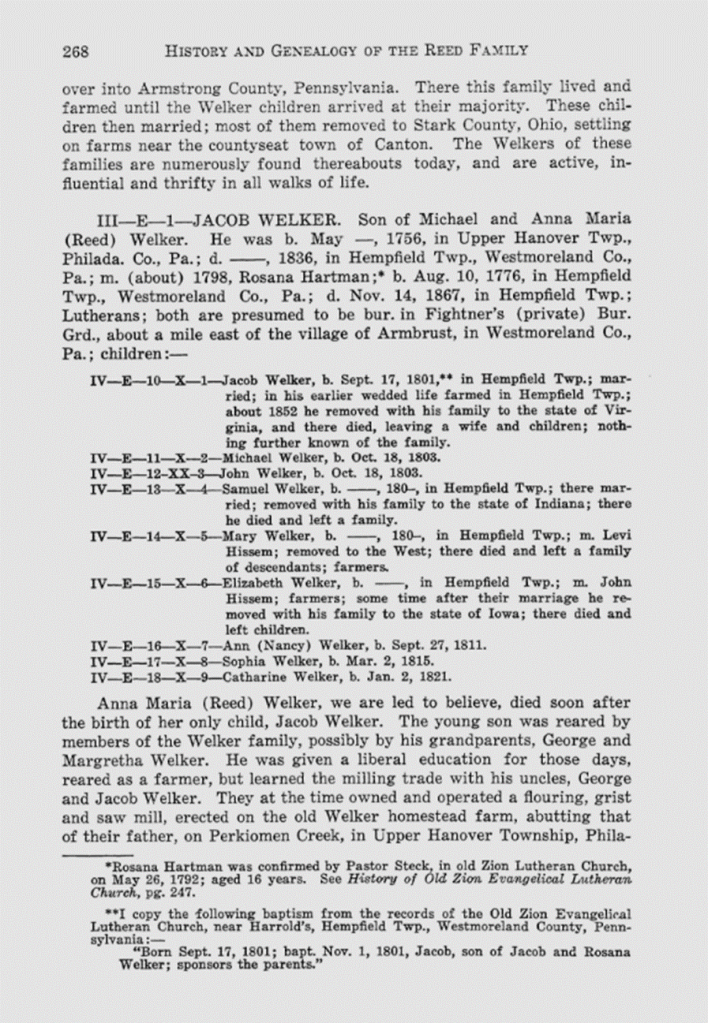
Some researchers believe that George Welker of Guilford County is the son of Michael Welker and Anna Read of Goshenhoppen, Pennsylvania.
Michael Welker is DAR ancestor A122003.[1]
[1] DAR Genealogical Research Databases accessed February 20, 2024.
The Reverend George William Welker 1817-1894 who was the pastor of the Old Brick Church for more than 50 years came to Guilford County later than George Welker. He is said to be the grandson of Michael Welker and Elizabeth Wagoner. His father was Daniel Welker.[1]
[1]Find A Grave at Rev George William Welker (1817-1894) – Find a Grave Memorial accessed February 20, 2024.
The History and Genealogy of the Reed family gives a good biography of Michael but does not provide evidence that George Welker of Guilford is the son of Michael Welker of Pennsyvania. However, it does not disprove that it is a possibility.[1]
[1] History and genealogy of the Reed family : Johann Philib Ried, Rieth, Reidt, Ritt, Rit, Rudt, etc., in Europe and America, an early settler of Salford Township (New Goshenhoppen region) Philadelphia County, Pennsylvania (familysearch.org).
Amick Family
The 1793 will of Nicholas Amick provides evidence that George Welker married an Amick daughter.
In the distribution, Wilker (George Welker) is paid 28.1.9 pounds as an heir on the right of his wife.
Nicholas Amick born May 24 1719 in Uttenhoffen, France. He was the son of Johannes Emig and Eva Dorothea Rotter. The Emig family arrived in Pennsylvania around 1732 and spent time in Pennsylvania, then moved to North Carolina between 1750 and 1760. Nicholas married Eva Margareta Rausch in 1736. They were members of the Lutheran church. Nicholas died in 1798.[1]
[1] Nicholas Amick (1719-abt.1798) | WikiTree FREE Family Tree accessed February 20, 2024.
Children of Nicholas and Eva:
Peter (1737 – 1815)
Philip (1745 – 1819)
Joseph (1750 – 1802)
John (1754 – 1832)
Fredrick (1759 – )
Barbara (1763 – 1847)
Jacob (1765 – 1846)
Magdalena “Molly” (1767 – 1832)
Will of Nicholas Amick
In the Name of God Amen I Nicholas Amock of Randolph County being of Sound and perfect Mind & memory blessed be God Do this first day of June in the Year of our Lord one thousand Seven Hundred and ninety three do make and publish this my Last Will and testament as in Manner as following that is to Say first I give full power and athority to my Administrator Executors and Asigns, after taking the Direct rule of the Law for to advertise a public Vandue in order to Sall the Goods and Chattles Left by me the Subscriber and then to Apply the money to the Support of my Dear and well Beloved Wife her Life time and after her Death to be Equally Divided Btween all my and her Children, __________ (here ?) In I appoint my Son John Amock and Christon Brower Executors of this my Last Will and testament in Witness whereof I the Said Nicholas Amock have to this my Last will and testament have Set my hand and Seal the day and Year Above Written Signed Sealed published and Declared by the Said Nicholas Amock the testator as his Last will and testament in the presents of us
Test. Alexr Campbell Nicholas Amack Seal
John Overley
Soloman Miller
Randolph February Term 1798. The Execution of the above Last Will & Testament was duly proved in Open Court by John Miller & ordered to be Recorded the Executor in Said Will named qualified as Such. Test. J Harper
*Place of burial is uncertain*
If anyone else has anymore information on his place of burial, please feel free to let me know.
Maria Sophia Hagee’s Parents – Conrad Hagey 1765-1831 and Mary Magdalena Clapp 1768-1845
Mary Sophia Hagee’s parents were Conrad Hagey and Mary Magdalena Clapp.[1] Conrad came to Guilford County from Pennsylvania. His father and mother were Hans George Hage and Anna Eva Frey. His father was from Elsenz, Landkreis Heilbronn, Baden-Wurtemberg, Germany. Anna Frey was from Alsace, France. The Clapps were from Germany and had come to North Carolina from Pennsylvania.
[1] Geneanet Community Trees Index – Ancestry.com.
Conrad Lived on the waters of the Alamance, southeast of Greensboro, where Conrad owned a tract of 210 acres. He died intestate. By deed of 29 July 1824 the heirs of his estate conveyed this land to Adam, son and legatee, who was therefore the recipient of one-ninth of the estate. John Philip CLAPP was a very substantial planter, and his will, proved Nov 1798 was one of the earliest recorded in
the county. [1]
The other heirs of the estate which was transferred to Adam include[1]:
John Hagea his mark Seal
Jacob Hagea his mark Seal
Sally Hagea her mark Seal
Jacob Clapp his mark seal
Barbary Clapp her mark seal
Abram Coble his mark seal
Sophia her mark seal
Jacob Nees his mark seal
Joseph Clapp his mark seal
[1] Guilford County Register of Deeds Book 19, Page 400.
Descendants of Christina Hagey share Ancestry DNA with Adam Hagey and Catherine Ingold, Jacob Hagey and Elizabeth Morrell, Sally Hagey and John George Lowe, Barbara Hagey and Jacob Clapp, and Christine Hagey and Jacob Nees.
Conrad and Magdalena Clapp Hagey are buried at Low’s Lutheran Church in Whitsett.[1] His estate was administered by his son in law, Jacob Neese.[2]
[1]Find A Grave at Conrad Hagy (1765-1831) – Find a Grave Memorial accessed February 20, 2024.
[2] Conrad Hagee, “North Carolina Estate Files, 1663-1979” • FamilySearch accessed February 20, 2024.
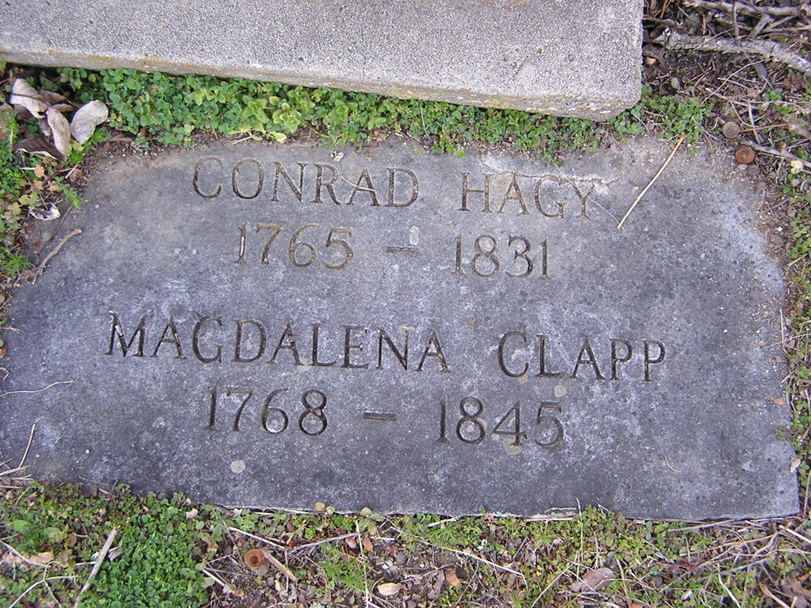
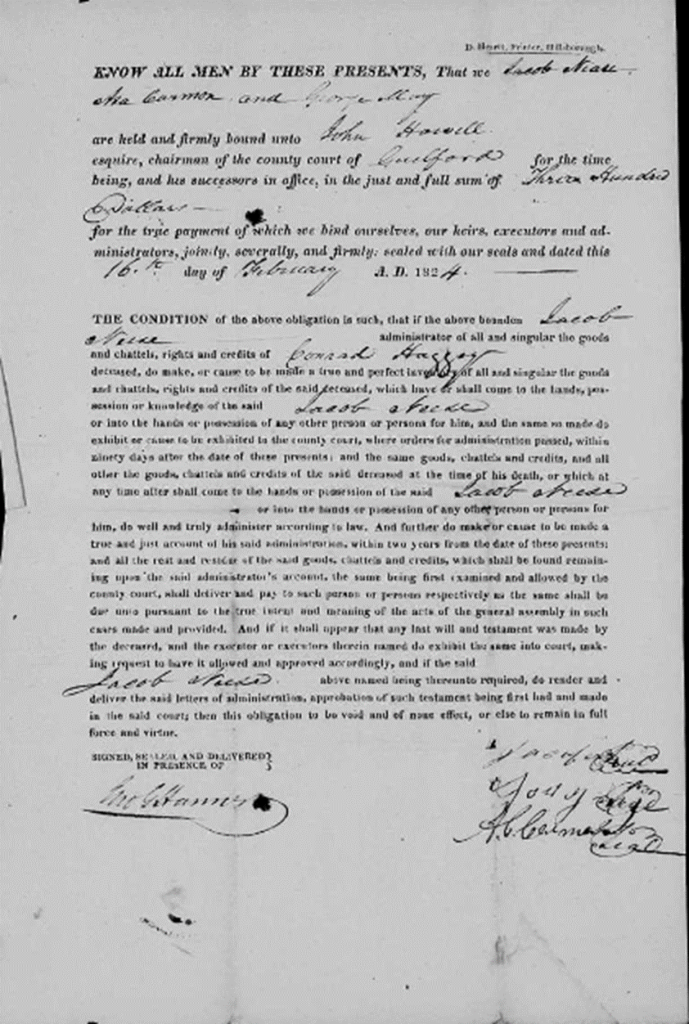
Maria Sophia Hagee’s Paternal Grandparents – Hans George Hage 1695-1770 and Anna Eva Frey 1718-1798
Immigration: “Hans George Hage came to America, PA, ship ‘Dragon’, captained by Charles Hargrave on 30 Sept., 1732…One hundred and eighty-five people were aboard the ship. The captain’s list of passengers gives all three names in succession as Hayea. In the oath of allegiance and oath of abjuration lists, Hans Georg’s name appears as Hans Jergi Hegi (from Strassburger’s Pennsylvania German Pioneers, Vol. I, pages 96, 98). In Rupp’s Collection of Thirty Thousand Names .., page 83, the surname is spelled Hagea…He settled in Lancaster County, PA, where he took up a tract of 200 acres which lay in a branch of Muddy Creek in the Ease Cocalico township, south of the present town of Swartzville. He was granted this land by a warrant dated 22 May, 1734, and on 27 May, 1738, a survey was made. On 2 Apr., 1745, he sold his rights to Michael Harper, of Chester County, PA.[1]
Hans Hege married Anna Eva Frey January 20, 1736 in Muddy Creek, Lancaster, PA. George received a 200 acre land grant May 27, 1738. He moved to NC about 1757. Anna was Moravian.
[1] Hans George (Hägi) Hege (abt.1699-abt.1781) | WikiTree FREE Family Tree accessed February 20, 2024.
There is shared Ancestry DNA with descendants of children Johannes George Hage and Rosannah Long, Anna Catherine Hege & Thomas Long, and Maria Barbara Hege & Johann Adam Hedrick.
Marie Sophia Hagee’s Maternal Grandparents John Phillip Clapp 1731-1798 and Barbara Marie Clapp 1737-1821
Marie Sophie Hagee’s grandparents were John Phillip Clapp and Barbara Marie Clapp. John Phillip Clapp was born in 1731 in Oley, Berks County, Pennsylvania. His parents were George Jorg Valentine Klapp and Anna Barara Stiess.[1] His wife was Barbara Marie Clapp. Some researchers say her parents were John Ludwig Clapp and Anna Margaret Strader. Ludwig Clapp was a first cousin of John Phillip Clapp. Other researchers say this has been disproved because Ludwig’s estate papers do not show Barbara Clapp, wife of John Phillip Clapp as an heir.
[1] Ancestry.Com. Geneanet Community Trees Index.
According to the biography of John Echols, a Virginia Quaker, John Phillip Clapp was involved in an incident where friendly Cherokee Indians were killed.[1]
It appears reasonably certain that John Philip Clapp is the “Philip Clapp” who, along with his brothers Tobias (George Tobias) and Joseph, in August 1758 participated in the murder and scalping of five friendly Cherokee Indians during an expedition to hunt down a party of Shawnees who had been ravaging white settlements along the Virginia and Carolina frontiers. The story, while it includes the three Clapp brothers, is told from the biography of John Echols (1721-1795), a Virginia Quaker who revealed the story, which was published in Lewis Preston Summers, “History of Southwest Virginia, 1746-1786, Washington County, 1777-1780” (Richmond, VA: J.L. Hill Printing Company, 1903), pp. 62-66.
The background to this event was that, in the spring of 1758, Indians had stolen a stallion from John Echols. Hoping to trade the Indians a less valuable horse for the one they had taken, Echols bought one from George Thomas, but a party of about 40 Indians took that one, too—and shot at John. About the same time, a party of militia under a Colonel Talbot encountered a man named Wollocks who had been robbed, stripped, and beaten by Indians; and, upon further investigation, the troops discovered that a number of homesteads in the area had been raided by Indians, the houses plundered and the inhabitants carried away. Consequently, beginning on Saturday, 12 August 1758, Captain Robert Wade led a contingent of about 35 Virginia and Carolina men from Mayo Fort to the New River in search of “our Enemy Indians.” A week later the party had reached Meadow Creek and was suffering “a great deal of Uneasyness,” particularly since one man had got lost, but by the time he found his way back to the company, a search party had gone out and was separated from those who stayed put under John Echols. While the rangers were encamped at Meadow Creek, five Indians approached and were nearly shot until they identified themselves as friendly Cherokees, not the dangerous Shawnees (who were allies of the French until the Treaty of Easton inaugurated a few months later on 26 October 1758) the militia was out to get. The Indians, however, had with them horses that the militiamen assumed were stolen and scalps that they assumed were white; and some of the rangers insisted that these Indians had to be Shawnee spies. The Indians were detained until Captain Wade returned and he passed upon them a sentence of death. Abraham Dunkleberry, a hunter who was temporarily with the company, objected, and the Indians were allowed to have their guns and leave. But after Dunkleberry had detached from the company, Captain Wade acceded to the grumblings of the Carolina men, for whom all Indians were alike and who chafed at “going ranging” if they were not going to kill any Indians. Thirteen of the company set off in pursuit of the Indians who were headed toward the New River and, after a couple of unsuccessful attempts, finally overtook the Indians at a peach orchard where they fired upon them, killing four outright and badly wounding the fifth, who made his escape in a trail of blood. The rangers “Skelpt them that we killed,” divided up the Indians’ goods, and then, on the morning of Monday, 21 August, the day after their little massacre, swore an oath not to reveal that they knew full well the Indians they had murdered were Cherokees. About eight months later, on 21 April 1759, the South River Quakers condemned their Friend, John Echols (or Eckhols) for “going with soldiers in pursuit of some Indians.” In August 1763, the Quarterly Meeting ordered a “paper of denial” to be read against him, which the Monthly Meeting carried out in October 1764. Nonetheless, on 18 March 1786, he was reinstated in membership. Note: According to Echols, the North Carolina men included Tobias Clapp, Philip Clapp, and Joseph Clapp. It would appear virtually certain that these were three brothers—all sons of George Valentine Clapp (1702-1773).
[1] Ancestry.Com. John Philip Clapp (1731-abt.1798) | WikiTree FREE Family Tree.
John Phillip Clapp came to Guilford County with his family around 1745. He was in the 1790 census with one male child and one female child and five slaves.[1]
[1]Ancestry.Com. Year: 1790; Census Place: , Guilford, North Carolina; Roll: ; Image:.
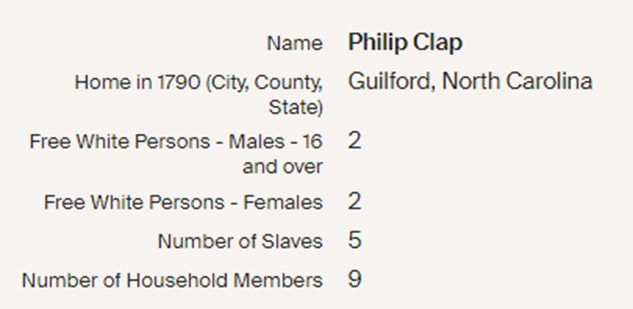
John Phillip Clapp also provided supplies to the Revolutionary War Cause thereby making his descendants eligible for DAR membership.[1]
[1] DAR Genealogical Research Databases accessed February 20, 2024.

When John Phillip Clapp died in 1798 in Whitsett, Guilford County, he had considerable property. His heirs including his wife Barbara were listed.[1] He was buried at the Brick Reformed United Church of Christ Cemetery which was known as Der Clapp Church or the Old Brick Church.[2] His wife Barbara Marie seems to have died prior to 1799 according to distribution documents. She is also buried at the Old Brick Church.[3]
[1] John Phillip Clapp’s Will (ancestry.com) accessed February 20, 2024.
[2] Find A Grave at John Phillip Clapp (1731-1798) – Find a Grave Memorial accessed February 20, 2024.
[3] Find A Grave at Maria Barbara Clapp Clapp (1737-1821) – Find a Grave Memorial accessed Ferbruary 20, 2024.
Will of John Philip Clapp
In the name of God amen, I John Philip Clapp of the County of Guilford and State of North Carolina, being of abundant health, sense and memory but considering the uncertainty of things which (undeph) future & knowing that it is appointed for all men once to dye do make, ordain and publish this my last will and Testament in manner and form as followeth:
Imprimus – I commit my body to the dust to be buried in a decent and Christian manner — my Soul unto the hands of the living God hoping for salvation through the mutilation of Christ Jesus. — And as to the worldly goods with which kind providence has blest me I will them to be distributed in the manner as followeth.
1st I will all my just debts to be well and truly paid after the discharge of which together with my funeral expenses
2dly give and bequeath to my eldest son Valentine Clapp the tract of land on which he now lives situated on the Alamance containing as is supposed 200 acres. I also bequeath him ten shillings to be paid in cash.
3dly I give and bequeath to my son Adam Clapp 412 acres on the water of Rock Creek on which he formerly lived with the above mentioned sum of ten shillings to be paid as aforesaid.
4th I give and bequeath to my son John Clapp the tract on land on which he now lives containing as is supposed 200 acres and the above mentioned sum of ten shillings
5th I give and bequeath to my son Luddowick Clapp the tract on land on which he now lives containing as is supposed 300 acres with the above mentioned sum of ten shillings
6th I give and bequeath to the children of my daughter Barbary Swing deceased, formerly wife of Mathias Swing one negro wench named Jenny and in the possession of Mathias Swing and her increase. to each of those children I likewise bequeath the sum of five shillings to be pd in cash.
7th I give and bequeath to my daughter Christina Albright wife to Phillip one negro boy named Franck and the sum of ten shillings to be pd in cash.
8th I give and bequeath to my daughter Molly Haguey, wife of Conrad Haguey that tract of land of which they now live containing as is supposed 210 acres, and the above mentioned sum of ten shillings.
9thly I give and bequeath to my daughter Catherine Brown, wife of Adam Brown that tract of land of which the said Adam Brown now lives, and the above sum of ten shillings.
10thly I give and bequeath to my daughter Mary Shaver, wife of Jacob Shaver one negro girl names Lydia, and the above sum of ten shillings.
11thly To my daughter Eve Burrow, wife of Ephraim Burrow I give and bequeath one negro girl named Nancy, and also the above sum of ten shillings.
12thly I give and bequeath to my wife Barbary all the remaining part of the real and moveable estate consisting of lands, negros, stock of all kinds, household furniture & instruments of agriculture all of which subject to her disposal at or before her decease.
13thly & Lastly I do appoint my wife Barbary and Daniel Cortner just to execute this my last will and testament agreeable to directions herein. Now in testimony to the aforesaid and (?) are perfectly agreeable to my desire and that it is my sincere wish that the execution of my will should be particularly attended to by my aforesaid executors.
I have hereunto set my hand and affixed my seal this 8th day of September 1797 John Philip Clapp (his mark)
Acknowledged, signed and sealed in presense of us Samuel Lindsay John (undeph) (jurat) John Cooper (jurat)
– Codicil –
Whereas I, John Philip Clapp now find myself in a low state of health and am apprehensive that I shall shortly leave this life these will certify that I still continue to approve the above mentioned will in all its parts and do constitute it my last will and testament with this alteration or addition that my above mentioned executors do make or cause to be made unto Ephraim Burrow my son in law a good and lawful deed of conveyance for the tract of land on which I now live containing as is supposed 494 acres agreeable to a memorandum of agreement entered into between me and sd Burrows which memorandum is now in possession of Samuel Lindsay on sd Burrow’s performing the conditions on his part therein mentioned, or on his giving bond and approved security to the satisfaction of my Executors for his well and truly performing all sd conditions on his part in sd memorandum mentioned.
In testimony of which I hereunto set my hand and seal this 29th day of September, 1798. Signed, sealed and acknowledged in presense of Samuel Lindsay Jacob Coble (jurat) Tobias Clapp (his mark)
NC Guilford County, November Court 1798 John Job and John Cooper proved the within Deed in Open Court and Jacob Coble proved the Codicil thereto — let it be recorded — then came in the Executors who qualified accordingly.
March 21 1799, we as heirs to the estate of John Phillip Clapp deceased and natural representatives of Barbara Clapp deceased do hereby declare to have recd of Daniel Cotner twenty nine a half coin dollars. By each of us whose names are hereunto affixed in whole amounting to 236 dollars. It being in full of our proportional share of the cashe found on hand belonging to the above estates at the time of _____Testators deceased Recd of Daniel Cortner as surviving Executor of John Philip Clapp and agent (by our special Consent to settle the Estate of Barbary Clapp or list from ____/
Catherine Brown her mark
______ Clapp his mark
William Burrow his Mark
Felty Clapp his mark
Hosannah Black Clapp?
Christina Albright
Jacob Shaver
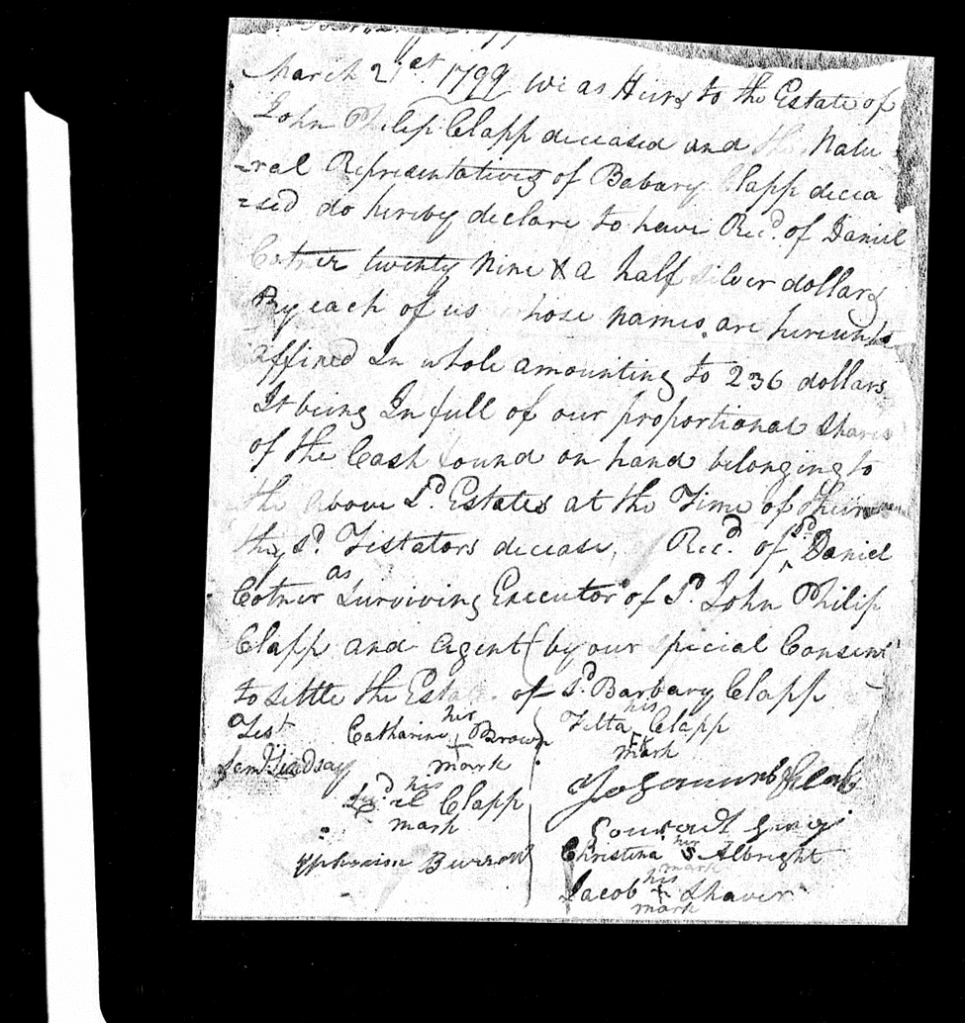
There are shared Ancestry DNA matches with Valentine Clapp and Sarah Maria Rogers, Adam Clapp, John Clapp, Lewis Luddwick Clapp and Margaret Ann Loy, Anna Christina Clapp and Phillip Albright, Mary Barbara Clapp and Matthias Swing, Catherine Clapp and John Adam Brown, Jacob Shaver (Shepherd) and Anna Maria Clapp, and Eva Clapp and Ephraim Burrow.
Hagey Family
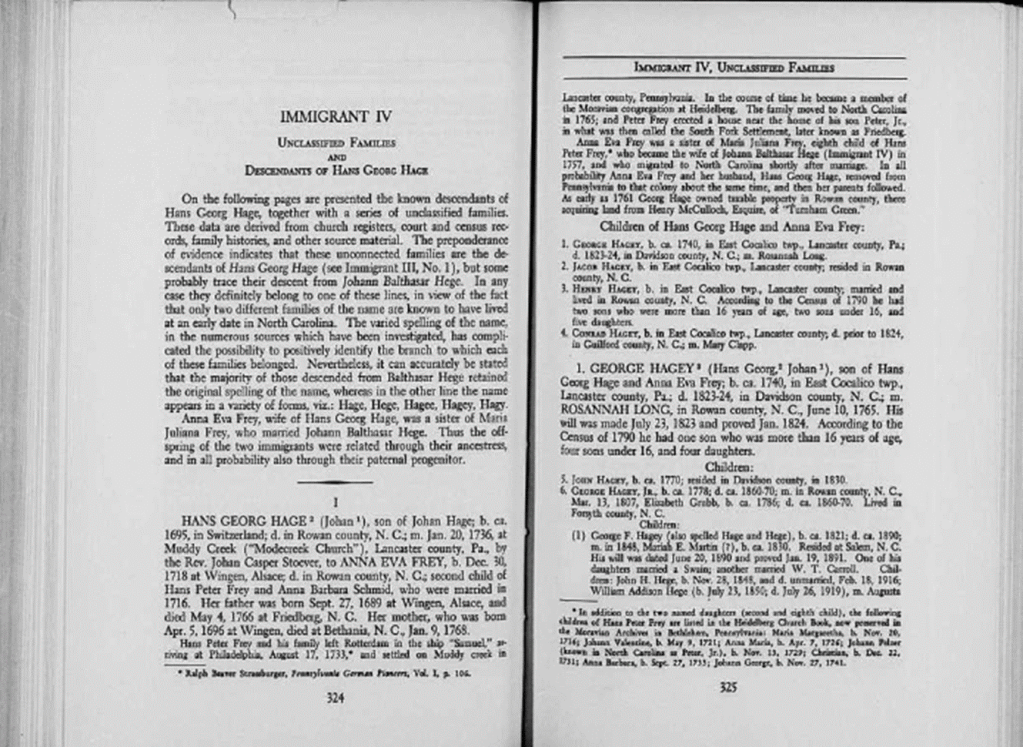
Hans George Hage was born around 1695 in Elsenz, Baden, Germany. His parents were Johan Jacob Hage and Anna Margaretha Steinmann. He came to America in 1732 on the ship Dragon. They were 185 Palantine Germans on board the ship. According to the Hagey Family Book, he immigrated with his father Johan, and his brother Johann Jacob.[1]
[1] Hans George (Hägi) Hege (abt.1699-abt.1781) | WikiTree FREE Family Tree.
Immigration: “He came to America, PA, ship ‘Dragon’, captained by Charles Hargrave on 30 Sept., 1732…One hundred and eighty-five people were aboard the ship. The captain’s list of passengers gives all three names in succession as Hayea. In the oath of allegiance and oath of abjuration lists, Hans Georg’s name appears as Hans Jergi Hegi (from Strassburger’s Pennsylvania German Pioneers, Vol. I, pages 96, 98). In Rupp’s Collection of Thirty Thousand Names .., page 83, the surname is spelled Hagea…He settled in Lancaster County, PA, where he took up a tract of 200 acres which lay in a branch of Muddy Creek in the Ease Cocalico township, south of the present town of Swartzville. He was granted this land by a warrant dated 22 May, 1734, and on 27 May, 1738, a survey was made. On 2 Apr., 1745, he sold his rights to Michael Harper, of Chester County, PA.
Hans Hege married Anna Eva Frey January 20, 1736 in Muddy Creek, Lancaster, PA. George received a 200 acre land grant May 27, 1738. He moved to NC about 1757. Anna was Moravian.
Hans Hage died in Rowan County, North Carolina around 1781.[1]
[1] Biographical and historical memoirs of Natchitoches Parish, Louisiana (familysearch.org) accessed February 20, 2024.
Frey Family
Anna Eva Frey’s parents were Johann Peter Frey and Anna Barbara Schmidt.[1] This article posted by Kent Creamer tells of the family’s emigration.[2]
[1] Ancestry.Com. Geneanet Community Trees Index.
[2] Frey-240.pdf (wikitree.com) accessed February 20, 2024.
The Early Emigrants The Zurich area of Switzerland was the home of our earliest known ancestors, Marti Frey and Ursula Wysy. Marti Frey was born about 1521, and Ursula in 1524. The Freys were Anabaptists, radical Christians who were persecuted by the Roman Catholic Church in the 16th and 17th Centuries. The name Frey meant “free” and was a common name taken by freemen, those who owed no indenture or loyalty to the aristocratic class. The Freys continued to live near Zurich, in the village of Knonau for several generations, until the end of the Thirty Years War, when the Edict of Nantes promised peace to the protestants. About 1650 Gregorius Frey migrated with his wife Varena (Oberdorfer) and several small children, north down the Rhine to the town of Wingen, Alsace. Alsace, now a part of France, came at that time under protestant control, and was a more hospitable environment for the anabaptist heretics. Beside the Anabaptists, among the settlers in Alsace were French Heugenots, Calvinists (the Reformed Churches) and Lutherans. In 1688, in an effort to expand his territory, King Louis XIV of France declared war on the Palatinate, and most of the German speaking villages of the Alsace were sacked by his troops. In 1689 the war was expanded and became The War of the Grand Alliance. Between 1689 and 1697, the French ravaged the Palatinate, precipitating the first migration of Palatine refugees to America and England. The Alsace territories on the west bank of the Rhine became incorporated into France. The winter of 1709 was another disaster for the war-decimated Palatines. Their homes burned by the French, thousands suffered a season so cold the Rhine froze over for months. The bitterness of that winter caused the second wave of emigration to America. There was a third wave of emigration in the 1730s. This time, it was the promise of land, employment and religious freedom that caused the people of Alsace and the Palatinate to leave their homes for a new land. In 1733, Johan Peter Frey, and his wife, Anna Barbara (Schmidt), set sail from Rotterdam for Philadelphia on the Samuel. With them were children Anna Eva, age 15; Valentin, age 12; Anna Barbara, age 10; Anna Maria, age 8; Hans Peter, age 4; and Christian, age 2. In Pennsylvania, Peter Frey joined the Moravian Church, and in the 1750s he was among a group of a fifteen men who traveled to North Carolina to purchase land from Lord Granville for a Moravian settlement. The men were welcomed and given lodging by a farmer named Johan Jacob Wagner, another ancestor of ours. Anna Eve Frey married Hans George Hage in 1736 at Muddy Creek Moravian Church (Berks County, PA). The Freys themselves did not migrate to North Carolina until 1765. Their daughter, Anna Maria Hege married Adam Hedrick, Sr.
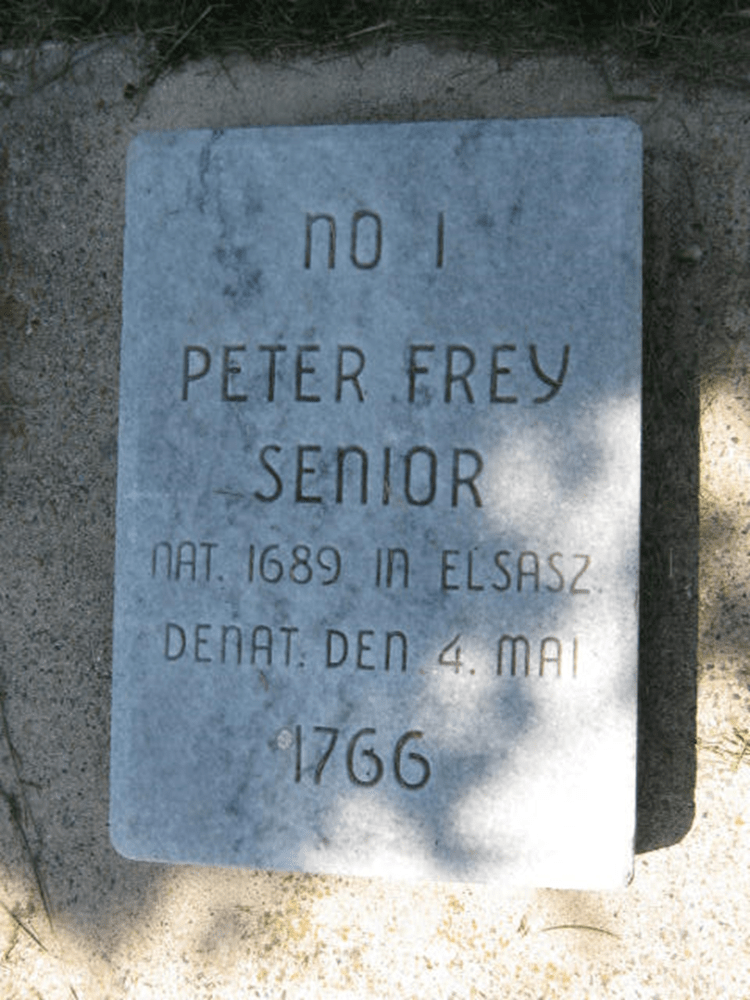
Peter Frey died in 1768. This is the story of his life from the Church Register of Friedberg Moravian Graveyard.
There is no memoir of Peter Frey, Sr. on file, but the following extended notice is taken from the Church Register of Friedberg Moravian Graveyard[1]:
“Peter Frey. He was born 27 September 1689 [his actual birth date is 7 September 1689] in Wingen in Alsace [now Bas-Rhin, France]; married in 1716, the widow whom he leaves behind; and during his married life, which lasted more than 50 years, he had 12 children, by whom he had 69 grandchildren and 20 great grand children.
“In 1733 he and his wife and seven children emigrated to Pennsylvania.
“In 1745 he was awakened by the testimony of the Brethren concerning the Atonement of Jesus, and was received into the little congregation at Muddy Creek [actually, Moden Creek in East Cocalico Twp., Lancaster Co., PA] and was admitted to the Holy Communion. When this congregation disbanded he and his family moved to Heidelberg [North Heidelberg Twp., Berks Co., PA] and there enjoyed the care of the Brethren.
“In May 1765, he moved to North Carolina, and built a little house near his son Peter. As long as he was able, he and his wife went to Bethania, and partook of the Lord’s Supper with the congregation there.
“Since last Christmas, 1765, he has been confined to his bed, had serious trouble in his chest, and longed greatly for release. Three weeks before that came he and his wife shared a blessed Communion for the Sick; and on the 4th of May 1766, the Savior took him to Himself. His age was 77 years, 7 months, and some days.
“On the 6th of May, after a sermon by Bro. Graff on the text: ‘Except a corn of wheat fall into the ground and die’, his body was interred, and thereby the burial place, already laid out on the Wachovia Line near the South Fork, was consecrated.” hip, Lancaster Co. PA, later moving with most of their children to Heidelberg township, Berks Co. PA. Their sons Peter and Christian moved to NC in the 1750s, and in May 1765 Johan Peter Sr. and the rest of his family joined them. He died the following year in NC, and was the first person interred in the new graveyard at Friedberg Moravian church. Anna Barbara died in January 1768, and is buried at Bethania Moravian church.
There is no separate memoir filed for Anna Barbara Frey, widow of Peter Frey Sr. in the Moravian archives, but there is a notice in the Death Record of congregation of Bethania, N.C.:
“Anna Barbara Frey was born on 5 April 1696, in Wingen in Lower Alsace [now Bas-Rhin, France]. In her 20th year she married Peter Frey, their union lasting something over 50 years. They had 12 children, and more than 100 grandchildren and great grandchildren.
“In 1734 she and her husband and 7 children moved to Pennsylvania, and settle on Muddy Creek. There she was awakened by the witness of the Brethren concerning the death of Jesus, and when a small congregation was organized there she was received and was admitted to the Holy Communion. When this little congregation disbanded she and her husband moved to Heidelberg; and from there, for the love of their children, they moved to North Carolina in the Spring of 1765.
“In May 1766, she was left a widow.
“Before Christmas, 1767, she came here [Bethania] on her last visit, and received much good through the festal and regular services of the congregation. The Savior granted her desire that she might be spared a long and painful illness, and might be taken quickly, which happened on January 9th of this year (1768) in the forenoon. Only a couple of hours previously she had been spinning, when she was taken with a severe chill and great pain in her chest. The last verse which she had been singing was:
“‘I am melted into tears when I sing of Jesus’ death.’
“Her age was 71 years, 9 month, 4 days.”
Peter Frey was the first one buried at Friedman Moravian God’s Acre in Davidson, North Carolina.[2]
[1] Hans Peter Frey (1689-1766) | WikiTree FREE Family Tree accessed February 20, 2024.
[2] Find A Grave at Johann Peter Frey Sr. (1689-1766) – Find a Grave Memorial accessed February 20, 2024.
The ten children of Johan Peter Frey and Anna Barbara Schmidt were:
1. Maria Margaretha Frey (1715-1785) m. Johann Michael Kapp (1705-1764), remained in Pennsylvania.
2. Anna Eva Frey (1718- ?) m. Hans Georg Hage, settled Rowan Co. NC.
3. Johann Valentine Frey (1721-1798) m. Anna Barbara Binckele (1722-1791).
4. Anna Barbara Frey (1723-?) m. Michael Lauer (ca. 1715-1789), remained in Pennsylvania.
5. Anna Maria Frey (1726-?).
6. Johann Peter Frey (1729-1810) m. Catharina Walk (1739-1815).
7. Maria Franzina Frey (ca. 1737-?) m. Adam Hartmann (1729-?).
8. Christian Frey (1731-1800) m. Sarah Schneider (ca. 1746-1826), had no children.
9. Maria Juliana Frey (1735-1814) m. Johann Balthazar Hege (1714-1785).
10. Johann Georg Frey (1740-1812) m. Anna Catharina Lerch (1747-1822).
Three of Johann Peter Frey’s sons seemingly failed to choose the side of liberty during the War of Independence. The Rowan County, North Carolina, Court Minutes of the year 1778 listed 577 persons who “refused or neglected” to take the Oath of Allegiance to the State. Most of these, we may safely assume, were Loyalists and/or Tories–that is, they were loyal, either passively or actively, to England, rather than to North Carolina or the United States. Roughly, out of around 3,000 families in the Rowan County area in 1778, one out of five were Loyalists/Tories. In 1778 Rowan County included the present-day counties of Rowan, Davidson, and Davie. In Captain Eakles District of Nonjurors we find listed the following names: “George Fry, Christian Fry and Peter Fry, Ser.” (North Carolina Genealogy. Winter Issue 1968, Vol. XIV, No. 4.)[1]
[1] freepages.rootsweb.com/~mitchvv/genealogy/narratives/peterf.html accessed February 20, 2024.
There are shared Ancestry DNA matches with the descendants of Maria Margaretha Frey and Johann Michael Kapp, Anna Eva Frey and Hans George Hage, Johann Valentine Frey and Anna Barbara Binkele, Anna Barbara Frey and Michael Lauer, Johann Peter Frey and Catherina Walk, Mary Juliana Frey and Johann Balthas Hage, Mary Franzina Frey and Adam Hartman, and Johann George Frey.
Clapp Family
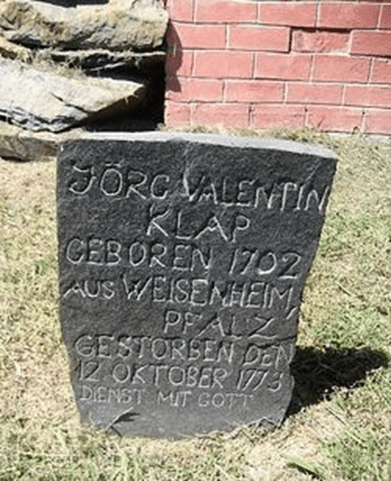
John Phillip Clapp’s parents were George Jorg Valentine Clapp & Anna Barbara Steiss. George Valentine Clapp was born on May 24, 1702 in Weisenheim, Am Berg, Germany. He married Anna Barbara Steiss on August 24, 1723 there.[1] They had two children there before coming to America in 1727.[2]
[1] Ancestry.Com. Geneanet Community Trees Index.
[2] George Valentine (Klapp) Clapp (1702-1773) | WikiTree FREE Family Tree accessed February 20, 2024.
In 1745 Jorg Valentine and Johann Ludwig (brothers) migrated south into Alamance County, NC near the present location of Brick Church (originally called Clapp Church). The church was formed in 1770, but many of the members had worshipped together since 1745.
Family History Overview of the History of George Valentine Clapp
by Claudia Cameron[1]
George Valentine Clapp was also known as Valentine. He was the first child of Jost and Anna Margaretha and he was born on May 24, 1702 in Weisenheim, Pfalz, Germany. He married Anna Barbara Stiess, daughter of Philip Stiess, on Aug 24, 1723 in Weisenheim. Anna Barbara was born in 1706 in Weisenheim. Their first born child was stillborn and the birth was recorded in the Weisenheim church book. Their second child, Maria Elizabeth, was also born in Weisenheim and lived to emigrate to America.
The last entry for Clapp in the Churchbook Weisenheim was in April of 1727. The family made their way to Rotterdam where they boarded the ship James Goodwill, with David Crockett as ship’s master. The ship made a stop in England and then continued to the Colonies. On Sept 27, 1727 in Philadelphia, Valentine was one of six in his family group who was a male aged 16 and up who took the oath of fidelity and he signed his name Jorg Valentin Clap. The signature looks as though Valentine almost wrote his last name as “K”lap, and then changed the first letter to “C” as he wrote to do it the “English” way as his father had done. The source for this record was the Minutes of the Provincial Council, printed in Colonial Records Vol. III, p.284.
The family settled in the Oley Valley, north of Philadelphia, in what is now Berks County, Pennsylvania. The rest of their children were born there.
In 1745, Valentine and others moved to North Carolina where land was available for purchase from either the current Lord Granville, or Henry McCulloch. What they found was favorable and they sent word for Valentine’s brother Ludwig and others to join them. Tradition says they first settled in the Beaver Creek section of Guilford County. This area is in the southern one third of the current Guilford, southwest of Burlington and south of Interstate 40. Between 1745 and 1771, numerous counties were formed and the boundaries changed with each formation. Valentine became a naturalized citizen Sep 22, 1763 in the Salisbury District, Rowan Co., NC.
Valentine and his family were members of the German Reformed religion. They worshipped at Low’s Evangelical Lutheran Church, where beliefs were similar, until 1770, when political differences reportedly prompted the Lutherans to lock out the Reformed members. At this point George and Ludwig were instrumental in establishing a church for their own faith at Beaver Creek.
Valentine purchased land a few miles further north near the Great Alamance Creek with a deed dated 1763. This land was located about two miles north of where the Brick church is now located. On May 19 1773, about five months before his death, for 250 pounds “George Valentine” deeded 320 acres of land to his son “George Tobias”. Valentine may have owned more land and transferred those lands to his other sons who remained in Guilford. He could also have just simply sold to Tobias. More research is needed.
Valentine died on Oct 12, 1773 in Guilford, NC, at age 71. He was buried at the Brick Church. The following is from the Brick Church record on page 97: “Valentine Clapp died Oct. 12, 1773 aged 71 years, 4 months, 2 weeks and 4 days. He was born May 24, 1702. He was married 51 years and had 12 children, 7 sons and 5 daughters. His body probably lies not far from the South East corner of the Church.” . In those times, burial was taken care of quickly, and the funeral service was arranged later. Rev. Samuel Suther (Suther and not Luther) delivered an address at Valentine’s funeral.
Anna Barbara died between 1774 and 1775 in Guilford Co., NC. She was also buried at the Brick Church. The record of buryings on page 99 states, “Valentine Clapp, born May 24, 1702, died Oct. 12, 1773, age 71 years, 4 months 18 days. [Anna Barbara Steiss – Wife of Valentine Clapp – born in Germany].”76Source Document Excerpt from Brick United Church of Christ History
by Reverend James R. Cress[2]
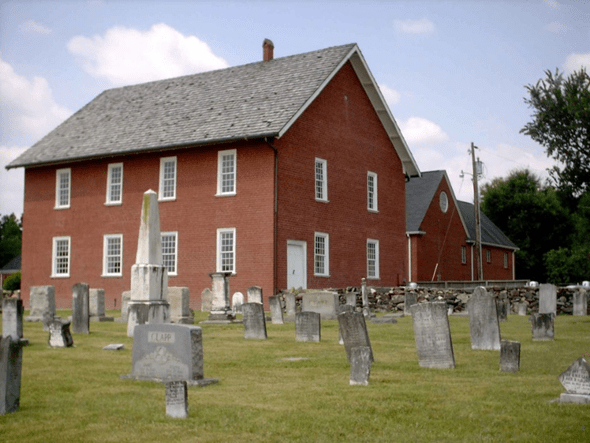
…”The beginning of Brick United Church of Christ dates back to the autumn of 1748 when George Valentine Clapp (Klapp) and his brother, Ludwig Clapp, from Berks County, Pennsylvania, entered Piedmont North Carolina and decided to settle on Beaver creek, near what was later to be known as the Guilford-Alamance County line.
According to tradition, a dream by the wife of George Valentine Clapp determined the site of the church, and because of its location, it was known in its earliest days as the Beaver Creek Church.
The Clapp brothers purchased their land from Henry McCulloh, who was an agent of the Colonial proprietor of North Carolina and these two German Families were the original founders of the German Reformed Church in Guilford County.
No doubt these people met for worship either in their tents or out in the open until the first cabins could be erected. In a short time, however, they were joined by other families who gave support to the young church.
Among these early settlers were the Albrights, Courtners, Mays, Swings (Schwenks), Greesons, Ingolds, Hoffmans, Fousts (Fausts), Ingles, Linebergers, Reitzells, Sharps (Scherbs), and Shepherds (Schaeffers). Soon a schoolhouse was erected near the site of the present church buildings and the small congregation gathered together here each Lord’s Day. The name commonly given to this congregation by this time was Der Klapp Kirche (The Clapp Church) because of the extended efforts of the Clapp family to erect for the community a house of worship…
…There is, however, no official written record that the congregation was organized until about 1770 when Rev. Samuel Suther (1770-1781) provided the first permanent ministrations of the Gospel to these people. At this time, the congregation was worshipping in a small log house built jointly by the Reformed and Lutheran people, located where Low’s Lutheran Church presently stands. During the Revolutionary War, however, Rev. Suther and the Reformed people returned to their schoolhouse to worship, presumably because of differences in interpretation of the Sacraments and the question of war itself, for almost every Reformed member was a patriot, while the Lutherans were almost all loyalists. “Comments Notes for Anna Barbara “Barbary” (Spouse 1)For many years the descendants of the Jorg Valentine Klap had thought that his wife was Mary “Elizabeth” Albright. It has since been discovered that she was actual Barbara Steiss. It is she, presumably, who had the vision of the Brick Church.
“The story is told that Jorg Valentine Klapp’s wife envisioned in a dream a rolling hillside, verdant and fertile, a new home in North Carolina. To her amazement, it was the same site she observed in 1745 when she arrived in the Piedmont with her husband, Jorg Valentine Clapp.”
George Valentine Clapp died in 1773 and was buried at the Brick Church Cemetery in Guilford County[3], North Carolina.[4] His wife Anna Steiss Clapp was buried there when she died in 1775.[5]
[1] George Valentine Clapp (1702 – 1773) – Genealogy (geni.com) accessed February 20, 2024.
[2]Full text of “Histories of United Church of Christ in Burlington and Alamance County, North Carolina” (archive.org) accessed February 20, 2024.
[3]Brick Reformed United Church of Christ Cemetery in North Carolina – Find a Grave Cemetery.
[4] George Valentine “Valentin Klapp” Clapp (1702-1773) – Find a Grave Memorial.
[5] Anna Barbara “Barbary” Stiess Clapp (1706-1775) – Find a Grave Memorial.
George Valentine Clapp and his wife Anna Steiss Clapp are reported to have had 12 children. Children listed at Steve Clapp’s web site[1] include:
- Infant Clapp 1725-1725
- Maria Elizabeth Clapp 1726
- John Phillip Clapp 1731-1798
- Maria Veronica Clapp 1733
- Jacob Clapp 1734
- George Tobias Clapp 1735-1800
- Joseph Clapp 1741
- Maria Barbara Clapp 1742-1807 married George Cortner
[1] steveclapp.com/Gen/Thomas Clapp/index.htm.
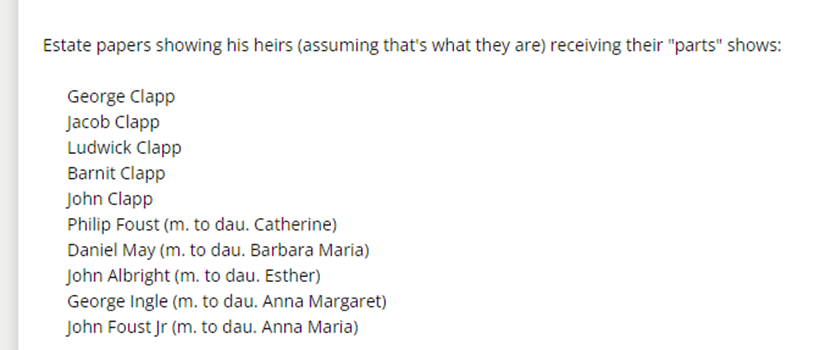
John Ludwig Clapp was the brother of George Valentine Clapp. He married was married to Anna Margaret Strader in Germany. They both came to America aboard the same ship as brother Valentine, the James Goodwill. Both settled in Guilford County, close to the Guilford Alamance County line.[1] Many researchers list Barbara Clapp, the wife of John Phillip Clapp as a child of John Ludwig Clapp and Anna Margaret Strader. However, other researchers believe that this is not true. Her name does not appear in his estate papers as receiving a “part” of the estate.[2]
[1] Find A Grave at Johann Ludwig “John” Klop Sr. (1704-1778) – Find a Grave Memorial accessed February 20, 2024.
[2]Johann Ludwig (Klapp) Clapp Sr. (abt.1704-1778) | WikiTree FREE Family Tree accessed February 20, 2024.
There is shared Ancestry DNA with descendants of George Tobias Clapp and Anna Mary Glass, Maria Barbara Clapp and George Cortner, Jacob Clapp and Mary Christina, and Joseph Clapp and Mary Julian.
Many of the Guilford County Clapps were involved in the Revolutionary War. This is a list of the Clapp Patriots with Guilford ties listed at the DAR site.[1]
[1] DAR Genealogical Research Databases accessed February 20, 2024.
- Adam Clapp 1754-1841
- Barney Clapp 1764-1844
- George Clapp 1739-1806
- Jacob Clapp 1747-1832
- John Phillip Clapp 1731-1798
- Leodwick Clapp 1742-1834
- Tobias Clapp 1743-1800
The Clapps were also involved in the Regulator movement and were very close to the Battle of Alamance[1] which took place in May of 1771 which was the final battle of the Regulator movement, a rebellion in North Carolina against taxation, local control, and corrupt land and deed practices.
[1] Map of Alamance County, North Carolina (William Luther Spoon) :: North Carolina Maps (unc.edu) accessed February 20, 2024.

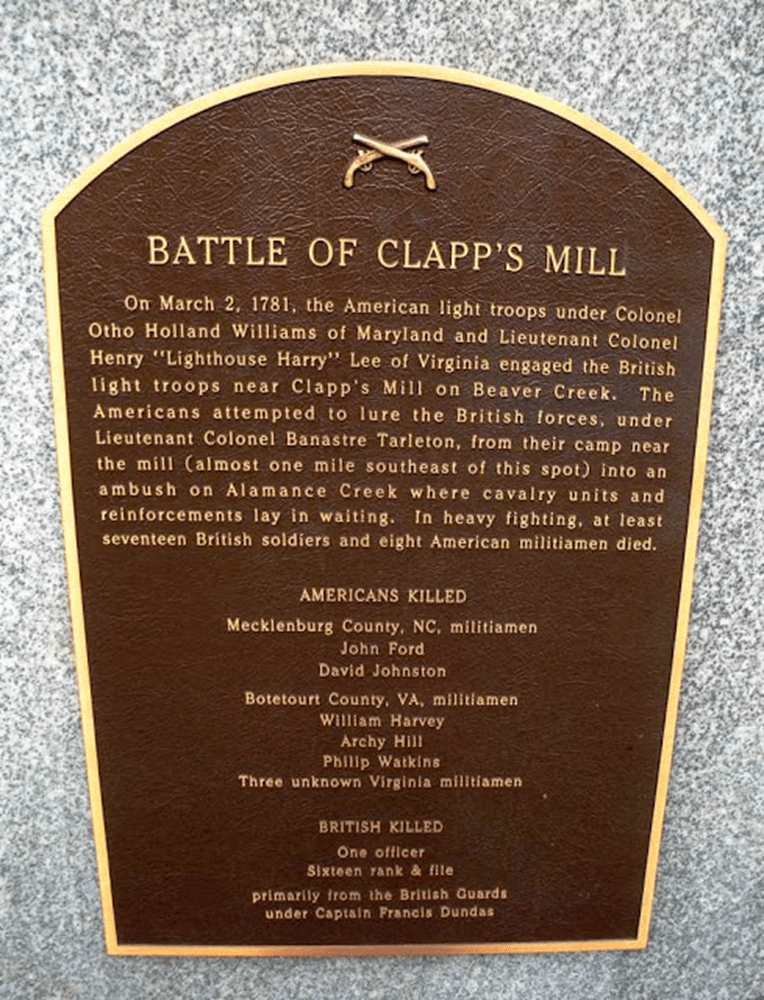
The Clapp Mill was also the site of a Revolutionary War Battle in 1781.[1]
[1] Battle of Clapp’s Mill (steveclapp.com) accessed February 20, 2024.
Conclusion
Abram Fox Coble was born in 1798 in Orange County, North Carolina and what is now Southeast Guilford near the Alamance County line. His grandparents were German immigrants coming to North Carolina from Philadelphia. They were Palantine Germans who came to America to escape poverty and to find greater economic opportunities. Once in Pennsylvania, Abram’s ancestors came south to North Carolina because of the promise of cheaper land. They came down the Great Wagon Road. Some settled in Rowan County and then came to Guilford. Some came to Guilford and found they liked it so didn’t go any further.[1]
[1] The Great Wagon Road (carolana.com) accessed February, 4, 2024.

Mary Sophia Coble was also born in Orange County, now Guilford County. Her parents lived in what is now southeast Guilford County, close to the Alamance County line. Her grandparents were also Palantine Germans coming to Pennsylvania and then to North Carolina. The Hageys settled in Rowan County and her grandmother Frey was a Moravian who lived in Friedberg Moravian settlement.
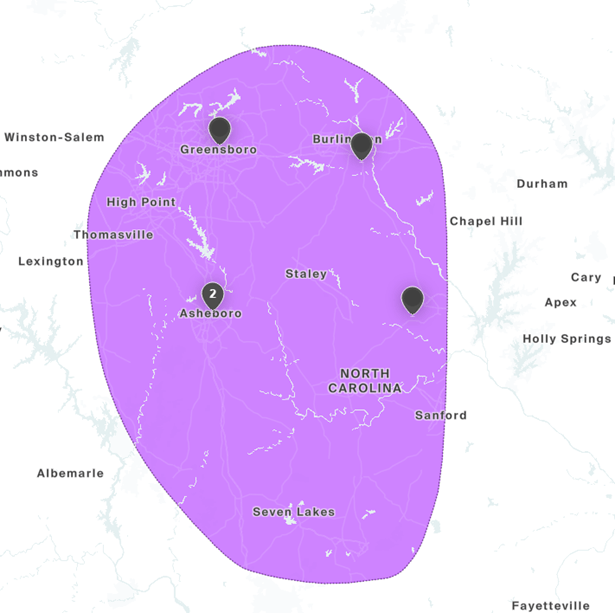
The descendants of Abram Fox Coble and Maria Hagey Coble who stayed close to Guilford County generally descended from siblings Abner, William, Alfred, Dillie and Letitia. This settlement location is described as Triad Settler location by Ancestry. The descendants of Joel George Coble are generally found in Carroll and Wythe County, Virginia. The descendants of Elias Coble are found in Richmond and Scotland County. John Coble and wife Martha Jane Breedlove traveled to Morgan, Indiana. Other descendants traveled further to places like Hagerstown, Maryland and Sagadahoc Maine. A few descendants ended up in California where some worked in the Orange and Lemon industry. There were at least two descendants who ended up in Canada.
Abram Coble’s sons were small farmers as were many of the neighbors and kin. One worked as a turpentine hand in his youth. None appeared to have owned slaves. Their kinsman Reverend George Welker preached against slavery. As time progressed descendants they worked in factories, construction, coal mines, and corporations. Some had exciting professions such as Chief of Police for the United States Supreme Court and one worked for the Apollo program which succeeded in landing the first humans on the Moon from 1969 to 1972. One common theme was family businesses such as Coble Dairy Products. Quality Wholesale Florists, Seago Beer Distributors, and Lexington Chair Company were examples of family businesses which flourished.
There are several ancestors of Abram and Sophia who worked on the side of liberty in the War for Independence. George Coble 1733-1816, Johann Michael Welker 1733-1799, and John Phillip Clapp 1731-1798 were three of the Patriots. Three of the Frey ancestors did not take the oath of allegiance and appear to have been loyal to England.
Three of Abram Coble’s sons were Confederate soldiers: Abner, Joel “George,” and Elias all served in the Confederate cause. Dillie’s husband, Private Daniel Breedlove lost his life at Richmond where he died of pneumonia and is buried in Oakwood Cemetery there.
Many of Abram Coble’s descendants served in World War I, World War II, Korean War, and the Viet Nam War. Several lost their lives:
- Mildred Coble Hemphill’s husband Harvey was killed in action in World War II in Italy in 1944.
- Herbert Harold Crowder died in Vietnam in 1967 in a helicopter crash on a resupply mission.
- Cletus Raymond Coble died at Fort Riley in 1945 after a short illness.
- Roy Woodrow Dabbs was killed in action in 1945 in Germany.
Abram Fox Coble and Maria Sophia Hagey were German Reform Lutherans. Their ancestors and kin were either Lutherans or Reformed Lutherans or Moravians. Churches that were important to them include:
- Coble’s Lutheran Church in Guilford County Clay Township, North Carolina
- Old Brick Church in Whitsett, North Carolina
- Pleasant Grove Baptist Church in Rockingham, North Carolina
- St. Paul’s Methodist Church in Diggs, North Carolina
- Friedburg Moravian Church in Davidson County
- Coulson Church of the Brethern in Carroll County, Virginia
- Shiloh United Methodist in Liberty, North Carolina
- Mount Tabor Community Church in Asheboro, North Carolina
- Spoons Chapel Christian Church in Asheboro, North Carolina
- Low’s Lutheran in Whitsett, North Carolina
There is no evidence of what Abram Fox Coble and Maria Sophia Hagey died from. However, the descendants who lived to adulthood seemed to have died of things that people died from today: Old age, heart attacks, strokes, cancer, and accidents. There are probably those who died in 2020 or 2021 who died from Covid. What is heartbreaking is the children’s deaths. The children died from many things that are preventable today such as prematurity, gastritis, mumps, diphtheria, malnutrition, and polio. Many died from accidental deaths such as drowning or farming accidents. One little girl fell in the wash pot and was scalded to death.
Another cause of death that seems to have been more prevalent in the Coble descendants is suicide. One person committed suicide by drinking carbolic acid and another killed himself on a train. Another shot their partner and then themselves. There were several young men who committed suicide after being in World War II.
The DNA study of this family and the traditional genealogy documentation provide few surprises and there are few brick walls. The one brick wall is the wife of John Phillip Clapp. However, she probably is no stranger. She was most likely another German Palatinate ancestor.
Except for the children John Coble and Martha Jane Breedlove Coble and Letitia Coble and Robert Hanner, the Abram Coble children had many descendants who led long joyful productive lives. They laughed, sang, fished, hunted, played bluegrass music and many went to church faithfully.
John Coble’s last two surviving children William H Coble and Letha Ann Coble Stickle were killed by fumes from a gas heater in 1931 in Marion, Indiana. The Marion coroner who was also the funeral home director was sentenced for soliciting a bribe because he threatened to attribute their deaths to suicide rather than to accident unless a bribe was paid. A suicide ruling would have violated accident insurance policies carried by the victims.
Letitia Coble Hanner only had one son, Jess Hanner. When she died in 1911, he had no close family. Jess Hanner was a convict guard who lived in Climax, North Carolina. He purchased a train ticket there on Monday, May 21, 1917. He got off the train at Liberty and waited for the Sanford train to arrive heading west toward home. He boarded the train and sat in the smoker section and when the train got almost back to Climax, he shot himself in the temple with a 38 Colt revolver.

 Martha's Family Connections